


Exploring Artworks…Karl Ullger’s ‘Forgotten Patio’
Today we look at ‘Forgotten Patio’, a painting by Karl Ullger currently on display at the GEMA gallery. The work won the first prize in the Gibraltar International Art Exhibition in 2021 and depicts a patio in the Road to the Lines area of Gibraltar’s Upper Town.
Karl, born in Gibraltar in 1982, studied for a BA (Hons) in Graphic Design at Leeds University where he developed a visual practice across photography, product design, marketing, video art, animation and Fine Art. Karl later chose to pursue a career in education and subsequently studied Art & Design at P.G.C.E. level. He is now Head of Art at Bayside School.
In 2015, Karl was accepted into the Royal Academy Summer Exhibition and, a year later, he was selected from more than 600 artists to become one of just 48 participants in Sky Arts Landscape Artist of the Year 2016. In 2020, four Gibraltar postage stamps were released featuring four of Karl’s paintings depicting Gibraltar’s new schools. In 2021, he published Lockdown with Cane-Yo, a book documenting a collection of figurative paintings produced during the pandemic. Since then, has been awarded First Prize at the Gibraltar Spring Visual Arts Exhibition, a Cultural Award, and, most recently, he has been involved in Traces of Humanity, an artistic project connected to Gibraltar’s prehistoric heritage.
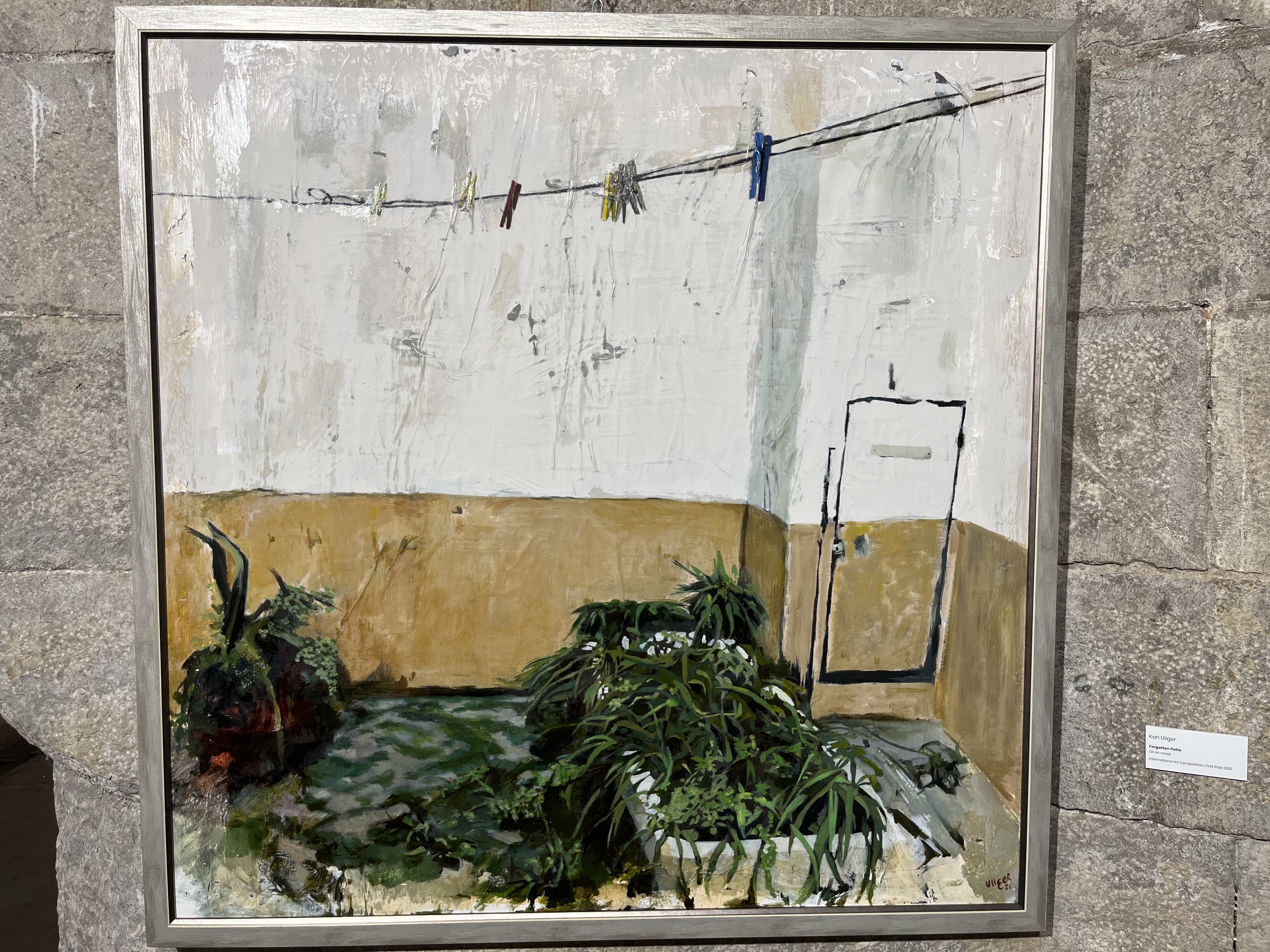
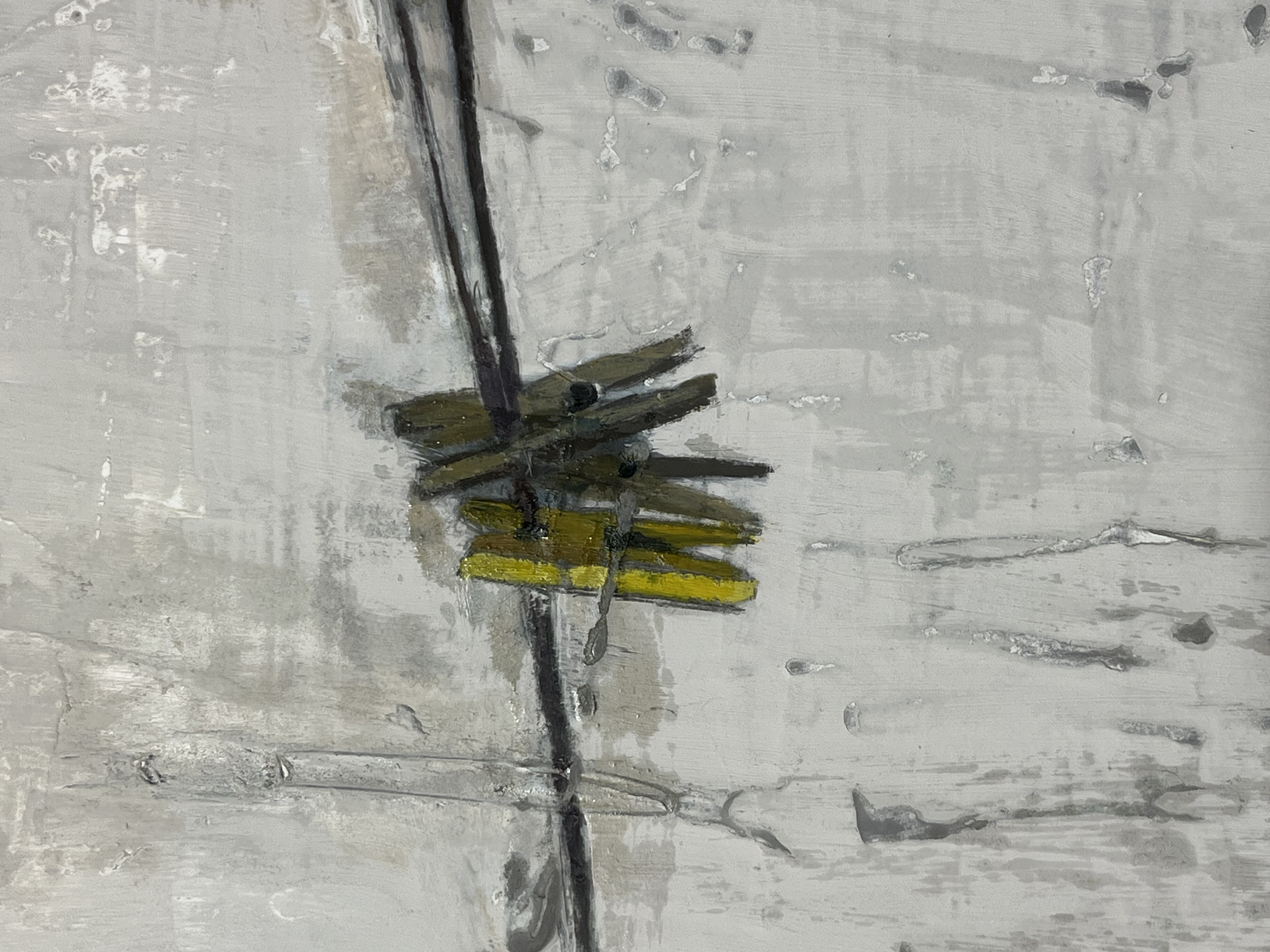
Karl speaks to us about ‘Forgotten Patio’: “I like to get lost in the Upper Town a lot. Whenever I see a photo on social media, it makes me want to go and explore that area. What caught my attention was that everything was very derelict—the plants were surviving, they were wild—but there was life. There was the colour of the pegs and the cupboard door has an element of mystery: what is inside?”
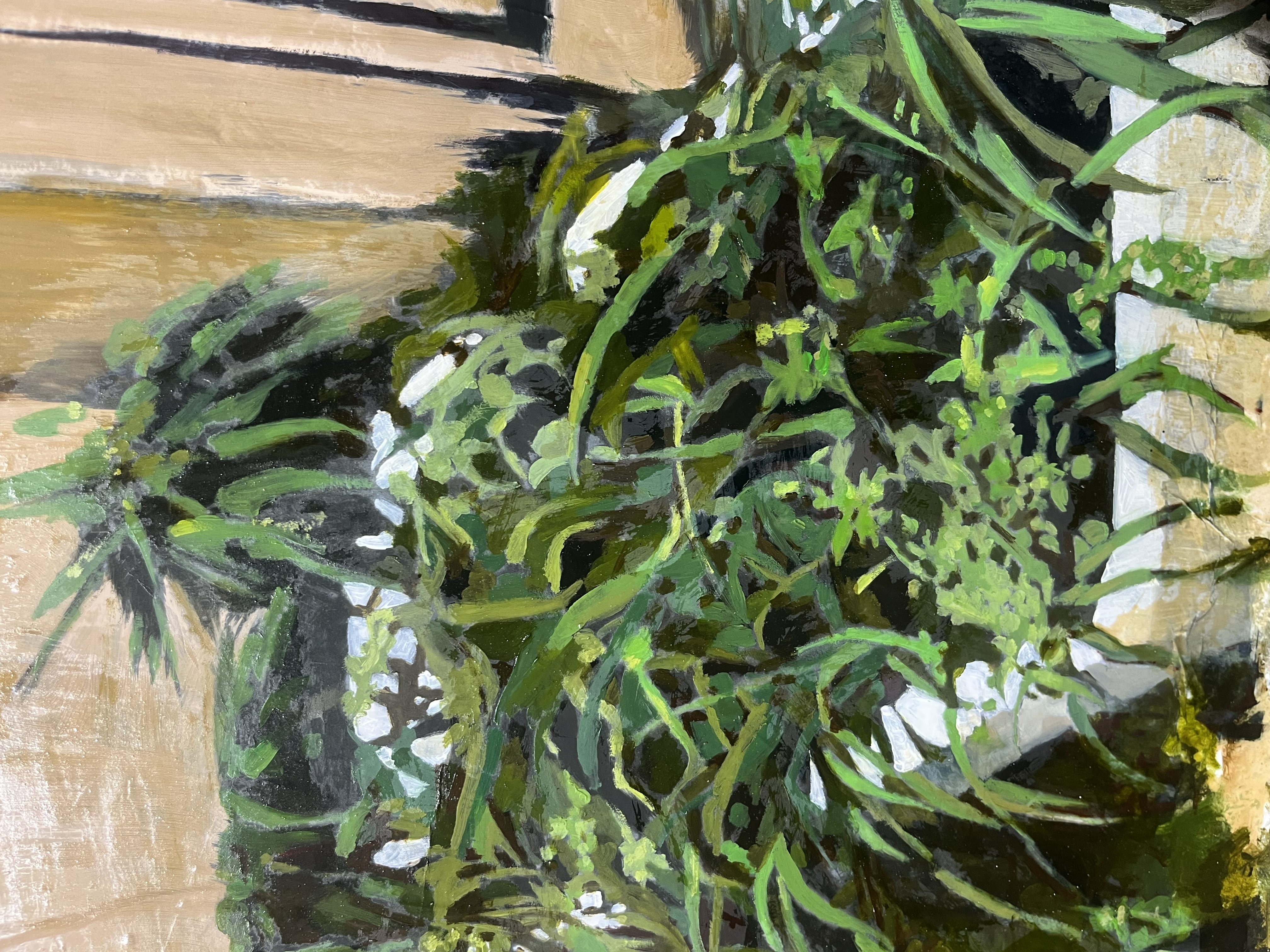
Looking closer, he explains that the weight of the painting is at the bottom with the plant pots, whereas the ‘lighter’ elements, like the clothesline and the pegs, are further up.
Karl explains that he liked the “rawness” of a rough pencil line for the clothesline and that he even used wall paint to get the tone and texture of the old wall just right.
If we look at the edges of the painting, there’s an unfinished aspect: the colour runs out or is very roughly applied. Karl says: “I leave some parts of my paintings unfinished because the painting sometimes needs that breathing space. The danger with having a lot of blank space in a painting is that you need to get away with a balance of tone, paint or objects. You don’t need to refine the corners—you can overdo it. You do not need to finish everything…that can often be visually more interesting than continuing the same colours as above in the rest of the painting.”
Kyrane Lia, an Art teacher at Westside School, said: “Karl Ullger’s ‘Forgotten Patio’ captures a quiet, nostalgic corner of Gibraltarian urban life, translating physical architecture into an emotional landscape of memory and the passage of time.”
She notes the artist’s use of “heavy, expressive palette knife marks and textured impasto to mimic aging, lime-washed walls, flaking paint, and worn plaster.”
Continuing her analysis, Kyrane adds: “The stark contrast between the warm ochre lower section and the textured off-white upper wall grounds the composition in local architectural tones. A stark washing line with mismatched wooden and plastic pegs stretches across the upper frame of the painting. Devoid of hung laundry, the pegs stand in like silent notes on a musical staff—remnants of daily human routines that are temporarily paused. The potted plants and trailing foliage cover the lower foreground, blurring into patterned floor tiles.”
She also notes the connection between the painting and Gibraltarian cultural practices: “In Gibraltarian culture, los patios inside traditional communal buildings served as the vital heart of daily domestic life. They were shared spaces where children spent endless summer afternoons playing freely under the watchful eyes of neighbours, while washing dried overhead and conversation drifted from open doorways.”
Pondering the work’s title, and the message the the painting might be sending us about our modern world, she concludes: “The title ‘Forgotten Patio’ lends a thematic layer to the painting. The absence of active figure work emphasizes stillness, turning the patio into a monument to a past era of childhood. It evokes memories of long, unstructured afternoons before screen time and digital distractions redefined leisure. It also becomes a metaphor for simpler times—a quiet sanctuary while the modern world moves rapidly outside.”
Next we spoke to Stefano Blanca Sciacaluga, of Kitchen Studios. He said that, in his own practice as a photographer, he was always looking out for the “perfectly banal things in life” which he defines as those things that are “often overlooked and not necessarily forgotten but just not noticed.” He says there are things that “ultimately to us, as human beings, are more important, or influential, or just take up more of our existence than the many other things people would want to photograph, paint or look at.”
He says: “As humans we exist in places: places that aren't necessarily fancy, curated and beautiful; and as such I've seen a trend in recent years in moving away from the show-offy nature of the modern world where we all have perfect skin, spotless homes and on top of it try to make it look like it's effortless.”
Having set up this alternative approach to what is worthy of aesthetic attention, Stefano argues that ‘Forgotten Patio’ “falls fully into this trend of telling it (or showing it) as it is and for what it is.”
He expands: “It's a patio, it's unkept, no-frills and the plants seem half-dead. They also look very run-of-the-mill foliage, we don't need to worry too much about them. It speaks to me because of its banal nature and reminds me of the work of other recent artists such as Noah Verrier, Pepe Baena Nieto but in particular Antonio Barahona, Andaluz and chronicler of daily patio life. And in this comparison it fits the Gibraltar narrative, to me. It's not a particularly Spanish-looking patio, which fits, and the light is reminiscent of a levante day, which I find interesting.”
Looking closely at the technique behind the work, Stefano says: “One thing of note, at least for me, are the brushstrokes which really add to the realism and relatability of the scene without being an ultra-realistic painting, which can sometimes be a bit over-the-top. I'm curious about this patio, why it seems in disuse, why there are no clothes on the line (again, the levante could be the culprit!) and where that door leads; it's a small door, certainly not a full-sized adult door but it's somewhat inviting. The yellow and the white I think are spot on for the subject matter, leading me to believe it's an actual patio and not an imagined space, which would fit right into Ullger’s portfolio.”
Art enthusiast Charles Durante joins the conversation with his take on Karl’s work: “We usually associate the ‘genius loci’ with groves and forests, mysterious places seemingly inhabited by an indefinable spirit. Karl Ullger’s patio is the antithesis of a mysterious place: an empty patio somewhere in the Upper Town, an unregarded corner of Gibraltar.”
Despite the unpromising nature of the the subject matter, Charles argues that it still “exercises its own fascination.”
He continues: “The first impression is that of slapdash work, hurriedly executed and clumsily composed. This first reaction is belied when we look closely at the painting: the gloopy, viscous white of the wall; the clothesline strung across the empty space, ready to receive the next batch of soaking clothes; the clothes pegs, left there, randomly clinging to the clothes line; the green vegetation, which seems to have overflowed its stone border and invaded the ground.”
Focusing on the plants, he says: “The shoots of the plant are tentacular and writhing; they are the only live thing in the painting (other than the flowerpot on the left), a contrast to the sterility and lifelessness of the wall and door. The twisting leaves are powerfully rendered in the painting; they seem to rebel against their confinement, intent on taking possession of the patio (they seem to have already conquered part of the ground with its undulating, greenish fur). They remind the viewer of the vicious plants in John Wyndham’s The Day of the Triffids! They represent a real explosion of vegetable life and confirm that nature will thrive even in the sterile atmosphere of the patio.”
Charles ends: “The clothes line, the off-white of the wall, the lower part in brown, and the stone border of the flower bed divide the painting into discrete sections; however, Karl has moulded them into a masterly whole which evokes the feelings of peace, silence and occasionally abandonment which characterise the Upper Town.”
Artist Lorraine Buhaghiar also contributes her input: “Once you become familiar with the artworks of Karl Ullger, his style is instantly recognisable and I have been fortunate enough to follow its evolution over the last twenty years or so. I consider him to be quite a prolific artist and there is already a large body of work that bears witness to the development of his technique.”
Lorraine calls Karl’s use of colour “clever”— “the combination of his signature palette of muted tones with contrasting bright accents can be seen in ‘Forgotten Patio’. The primary colours of the cheap, everyday clothes pegs provide some relief in this somewhat dull and neglected space. Being left on a makeshift washing line suggests that, at least, the patio may still have a practical use.”
She continues: “Whether imagined or not, it could easily be a little nook often seen in Gibraltar, where, although any outdoor space is much sought after and precious, the cracked walls and peeling paint are not uncommon. Perhaps in an attempt to beautify, there is the addition of a raised bed/trough but, sadly, the plants and inevitable weeds all appear to be struggling for survival. The mustard band of colour could be another attempt at decoration but the space remains in need of love and attention. Ullger captures the overall condition not only with his colour choices but also using texture, one of his strengths.”
She ends by noting the emotional tone of the work: “There is a notable absence of strong light, unusual for an Ullger work, but in this case it adds a sense of melancholy to the narrative of a memorable piece.”
To follow Karl’s creative process, catch up on:
Instagram: @ullger_art
Facebook: Karl Ullger Artworks