


What I’m Listening To… ‘Piano Postcards’ by Stephen Hough
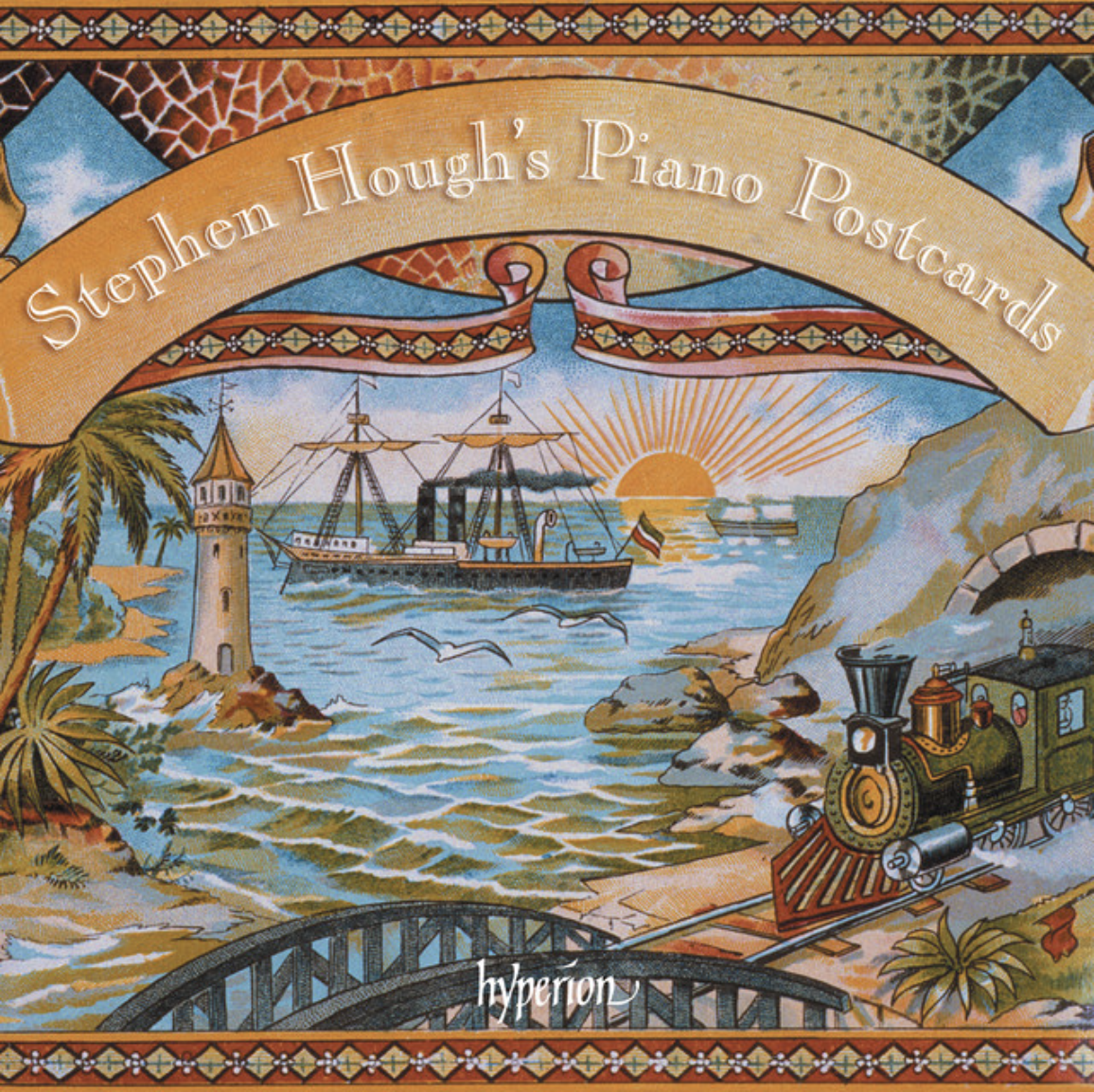
The ever-enterprising Hyperion Records’ star pianist, Stephen Hough, has released his latest album. Called ‘Piano Postcards’, the disc’s contents are best captured by culinary metaphors: this is a smorgasbord of works, musical morsels and tidbits, tapitas, if you will. ‘Postcards’, however, is just as appropriate as any other description mentioned above: the works are, indeed, brief messages sent from across the globe with works from Taiwan, the U.S and Russia.
Here, brevity is key: no piece is over five minutes long with most clocking in at around two or three minutes. The pianist himself, in a Guardian interview, sticks to the food imagery and refers to the 26 tracks as “after-dinner mints”. While some are typical encore pieces like Rimsky-Korsakov’s ‘Flight of the Bumblebee’, many are arrangements made by Hough and the real interest lies in these novel presentations of familiar tunes.
The album starts with Hough’s arrangement of the ‘Mary Poppins Suite’ by R & R Sherman. His treatment lends an extra depth to this light music—in Hough’s arrangements, a simple tune from a musical can be turned into a melancholy utterance. It’s important to recall Hough’s skills as a composer, too: I remember enjoying the organic growth of the musical material in his piano concerto ‘The World of Yesterday’ which was released last year on the same label.
Although one of the main historical purposes of arranging works for piano performance was to make music for multiple players like symphonies and concertos available for home performances, arranging has also become a creative process where the outcome is a distinct work in its own right. The art of arrangement is a reminder that music is endlessly varied and fertile. We just need to go back to Beethoven’s ‘Diabelli Variations’ to see how an unremarkable waltz can be the soil on which the most remarkable inventions are sown. That same spirit is in evidence here: pieces that in their original guise might be mere trifles, emerge as deeply considered, as worth pausing over.
Without working through each track, these were the ones that leapt out for me during a week’s listening:
The Kriesler ‘Liebesleid’—originally for violin and piano but played here in Rachmaninov’s arrangement— is so well known and done to death that one is liable to switch off. Not so with Hough’s rendition; rarely have I heard it played so sensitively as on this disc. Hough milks the piece for its syrupy Viennese charm too.
In ‘Flight of the Bumblebee’, Hough’s articulation is outstanding—each rapidly fired off note remains discernible to the ear. I was also glad to hear ‘Spring Breeze Prelude’ by Teng Yu-hsien, a Taiwanese Hakka musician. To encounter unfamiliar works flanked by repertoire staples is another joy of records like this.
I admit to feeling a jolt of pain as the strains of ‘Do You Want to Build a Snowman?’ from the kids’ film Frozen came on. All those who have become parents since 2013 will have been too traumatised by their toddlers belting this one out at 7am on a Saturday to listen with an open mind but, surprisingly, Hough’s arrangement is, once again, revelatory—he situates the work firmly in the sound world of Romantic era piano miniatures. Arrangements of songs from Mulan and Coco, with their immediate emotional appeal, complete the dalliance with Disney. These movie tunes are followed by the more substantial ‘Andaluza (Playera)’, from Granados’ Spanish Dances. Lingering trauma over!
If we revisit the culinary metaphors, Hough’s masterstroke is to include, roughly halfway through the disc, a stately Handel minuet (Minuet in G Minor arranged by W. Kempff) which comes as a sorbet or gulp of ice cold water—a palate cleanser midway through our gourmand’s feast.
It was also interesting to encounter two pieces by Malcolm Williamson. Although the Australian composer was the Master of the Queen’s Music from 1975 until his death in 2003, even musical connoisseurs would struggle to hum a single tune of his. He’s represented here by two winsome ‘Travel Pieces’.
The track that left the deepest impression, though, was the jazz standard ‘Nature Boy’. Composed by Ahbez and made famous by Nat King Cole, the tune’s meandering start leads to a dusky, main tune. Hough’s arrangement really emphasised the cryptic nature of this song.
Hough’s disc swings from the poundingly virtuosic to the reflectively poetic. From classical to musicals, from films to jazz. Hough’s playing is not prone to excesses: there’s no indulgent lingering on phrases and no overemphasis in the louder passages. Where, as here, the quality of the playing is taken as a given, we must look at the programming and artistic vision of the album. There is no doubt that this is a carefully considered recording—every piece, and its position in the album, has been chosen with regard to the overall balance and to exploit possible contrasts.
Hough’s piano sound is rendered naturally and it’s important that we do not hear the extraneous noise which is slowly creeping into recordings under the guise of ‘immediacy’ but is, for me, just distracting. At almost one hour and fifteen minutes of inventive music, this Hyperion release is tremendous value. Listen closely—this is not background music.