


Getting Into Culture….Poetry
We continue our new series where we ask artists, poets, novelists, musicians, dancers and others for tips to help beginners appreciate and learn more about their art form.
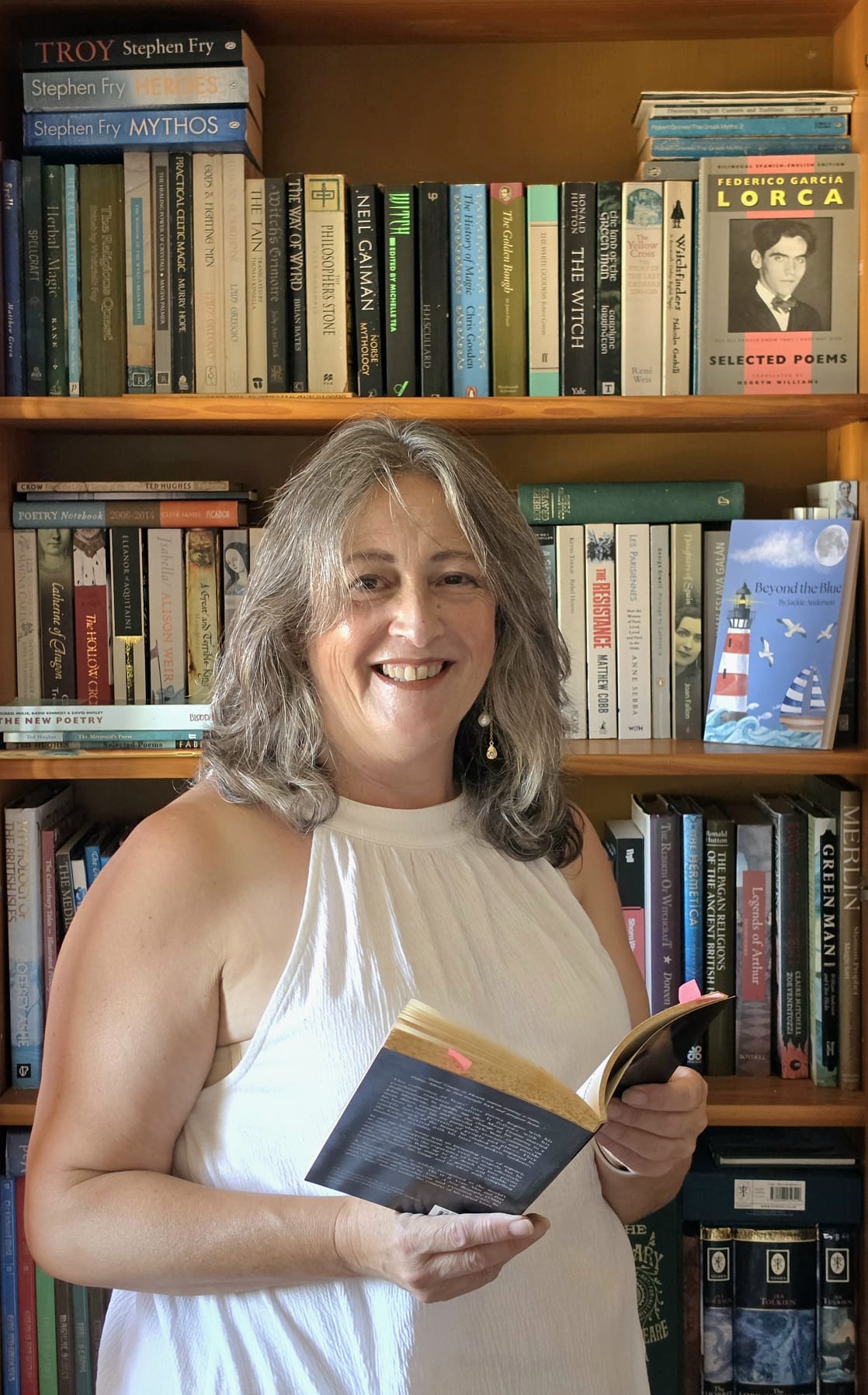
Today we speak to Jackie Anderson about poetry. Jackie has published two books of poetry and a collection of short stories. She has also written, with her daughter Ciara Wild, a book about Jack the Ripper. She has delivered writing workshops and was recently invited to the University of Cádiz to talk about her work.
YGTV: Why do some people find poetry so hard to enjoy and what tips do you have for someone who finds it difficult?
Jackie Anderson: I think there's a mix of answers to this question and most of them have to do with what we are used to reading as kids, how we are taught at school, the role modelling of parents and peers. After all, I've never met a child who doesn't love rhyme and rhyming verses, from Humpty Dumpty to Room on the Broom. When we are little we love words, and the sounds and rhythms that they make. For ten or more years I ran day nurseries and poetry was high among the popular sessions with kids as young as six months old, and their parents, and the nursery team. We all grew up loving songs and lyrics - these are all forms of poetic language. So there is clearly a place and time where we start to lose that love, where it becomes difficult and I think that happens, sadly, in the education system. Not that this is a moan about teachers - it's my pointing out that the system is not conducive to engender a love of poetry.
Think about how we learn Shakespeare, one of the world's greatest poets. Kids read out scenes from his plays in class. They fail to understand the meanings and the subtext of the words, because we are not Elizabethan and we don't get the innuendo and references and five-hundred year old jokes. So we're bored witless, we do it because we have to and then forget everything we're taught instantly and try to avoid poetry ever after. Same with the Romantic Poets - I hated Keats with a passion when I was thirteen. I mean who in their right mind decides it's of any sense or use to wax lyrical to an urn, Grecian or otherwise? I love Keats now, by the way, and have been reading his letters to Fanny Brawne this summer. My love for poetry was beautifully nurtured within my family (Mum used to recite Tennyson to me from memory and I still love reading The Lady of Shallot for its beautiful rhythm and images and sheer romance) and then at school by Miss Candeas at St Mary's Junior, who introduced me to Lewis Carroll and other poets, but it was almost destroyed at school, and I saw similar fates befalling my peers and my kids and now my grandkids. Poetry is so much more than regurgitating verses and 'what the teacher said' and passing exams.
Reading poetry is about sensing your way through the sounds of the words to reach a thought that is distilled to its purest sense. That's not always easy, but the joy of the journey is usually worth it. So I understand that some people find poetry difficult because they've not been able to work the keys that unlock the meaning of the poem, and that is what we need to learn about poetry - how not to fear it but to enjoy scrabbling about in the words until their meaning takes shape.
So I would say that many people find poetry difficult. I did, and I still do. Some people revel in writing poetry that's difficult to decipher. But for anyone who wants to try reading it, I'd offer these tips:
unless you had a brilliant teacher in which case you probably don't need these tips, forget everything you were taught.
go somewhere private and read the poem out loud, to yourself, to the cat, to the pictures on the wall, to the roses in the garden. Read it over and over again. Unless you are going to read something like The Lay of the Niebelung or In Memoriam, poems are usually fairly short.
look up words you don't know; it really helps if you know firstly their meaning and secondly any alternative meaning they might have because the poet might have been hiding the intended sense of the poem behind a front layer (because we like to make mischief among our readers!)
get the rhythm and sound of it rolling on your tongue, follow the punctuation: a poet will think long and hard about every comma, capital letter and full stop, because these all add to the meaning
do it over and over and you'll find that suddenly it starts to make sense; follow the pictures you get in your head, the feelings in your chest and you'll soon be picking up the emotion: emotion is always at the heart of a poem.
and don't worry if you encounter a poem you don't like or that makes no sense to you; we don't all like everything. Just move on to another poem or another poet.
start with kids' poems if you want and don't be shy about it; some are utterly brilliant. Test out Spike Milligan for the laughs or Michael Rosen, Edward Lear, Lewis Carroll. Lord Byron can wait. His brilliance won't fade while you get round to picking up a volume of Childe Harold's Pilgrimage.
and don't stop at poems in just your language, or your country or your culture - spread your wings and read poetry from all over the world; many translations are very good and keep the essence of the original poem. Poems are a form of travel, just without having to take your passport.
YGTV: How do you approach a poem? What do you look for when reading it for the first time?
Jackie Anderson: The emotion and the imagery. What does this poem make me feel? What does it make me see? It's usually instant, but sometimes, I won't quite get it. Usually, though, I get curious and drawn into the poem and that's when I re-read and start to take it apart, so I can find the feelings behind it. Once I get the emotion, I'll start to look at shape, structure, use of language, how the poet has engaged my senses. I often get gripped by rhythm and rhyme, not because they are necessarily rhyming couplets but perhaps there are internal rhymes or slant rhymes to a free verse poem that can add to the power of the poem and the emotion it conveys.
YGTV: Give me a list of three or four poems which have meant a lot to you as a writer and which a beginner could also enjoy.
Jackie Anderson: Such a tough question, so many poems out there...!
I think that the poems of Paul Verlaine which I read in French when I was studying my A level and Federico García Lorca which I read at the same time for my Spanish A level were what brought me back to reading poetry after the English department's failure to get me to find any joy in Gerard Manley Hopkins (whose poetry, half a century later, I find rather brilliant). Verlaine's capacity to offer beautiful and emotional impressions in just a few words fascinated me and I wanted to learn to do the same. Lorca was all about emotion. How can you read Lorca at sixteen and not have your blood stirred by the images, the passion and the stories that went with it? So I would pick Il Pleur dans mon Coeur (you didn't specify they had to be English) by Paul Verlaine because I was sixteen, angst-ridden with raging hormones, and Lorca's Llagas de Amor is wonderful and painful all at once, as is love. I also want to mention C'est un trou de verdure by Arthur Rimbaud, another French poet, because I read it over and over and over and it always made my sigh with sadness at the end. These poets got me wanting to write.
Then there was Seamus Heaney's Digging. I love Heaney's poetry. It makes me pause and think and feel. It makes me humble and want to write more and better and keep learning. I'll never be as good a poet as Heaney if I were to write for a thousand years but there's is something real and grounded about Heaney's poetry that makes me feel that it's ok to write and call yourself a poet and keep writing and keep learning.
And I can't not mention W.B. Yeats. Picking a poem by Yeats that has influenced as a writer is hard; I think his poetry influenced me as a person, it touched raw nerves in my emotional development and it still does. But perhaps my favourite is He Wishes for the Cloth of Heaven, because he loved and lost and all his pain is in this poem. I have already told my kids I want The Lake Isle of Innisfree read at my funeral (it's the only forward planning I've done). I bought my first book of Yeats' poetry at Thor Ballylee where Yeats lived for a while, and read it on a cold, cloudy Irish mountain and I was hooked.
But there are so many poems to choose from and so many talented poets, and often my proclaimed favourite will depend on my mood. I've recently been into Robert Burns but gosh, it's hard to read. I might have to learn Scots.
YGTV: How helpful is it to do research about the poem? Should you learn about the poet's life, look up interviews online and search for notes and analysis, or does this get in the way of enjoyment and make it more like a school project?
Jackie Anderson: I've already touched on my feelings about school and poetry, although I want to add that good teachers who themselves love and appreciate poetry make all the difference.
I would say that it's the poem that comes first, that as a reader you want to get to know and like the poem. But if I like a poem, I want to read more by that writer and then I find that learning about the writer and their work and their lives and the context whereby they wrote that poem or that collection forms an important part of my enjoyment and understanding of the poem. It's because I learned how young Keats was when he died that I was drawn back to reading his work and thank goodness that happened because imagine going through life without the beauty of Keat's poetry touching it? It was partly through Yeats' work that I went on to learn about Irish history, politics and mythology. Burns' passion and the down to earth bawdiness of his work speaks of the people of Scotland and their humour and their lives and their folklore; you can almost smell the heather when you read his work. He died young too. And as for Byron, reading his biography casts a light upon his poetry, you read it with different eyes, you find a further layer of meaning.
So I would heartily encourage people to find out more about the writer and their work, whether online via interviews or on their blogs, Substacks, social media and so on. I would also encourage people to go to poetry readings, listen to the words of the poets, by the poets themselves. Talk to them afterwards - we don't bite, in fact, we all love talking about our poetry and are all delighted to find someone who's actually ready our poems.
I would steer clear of making it a school project though. There's a line to be drawn between reading, enjoying, adding context and background, and writing a dissertation and the last of these is rarely fun. Poetry is for fun too, just try reading Brian Bilston. Or Jonathan Teuma for that matter. I've spoken a lot about English poets because these were the poets that populated the culture in which I was raised and lived so many years. Now Gibraltarians have their own poets that they can add to their libraries, and I would encourage them to read local poets; we have much to say, and some of us aren't that hard to read. And if we are, we're always happy to chat about the most obscure of our verses in exchange for un cafelito en el pueblo!