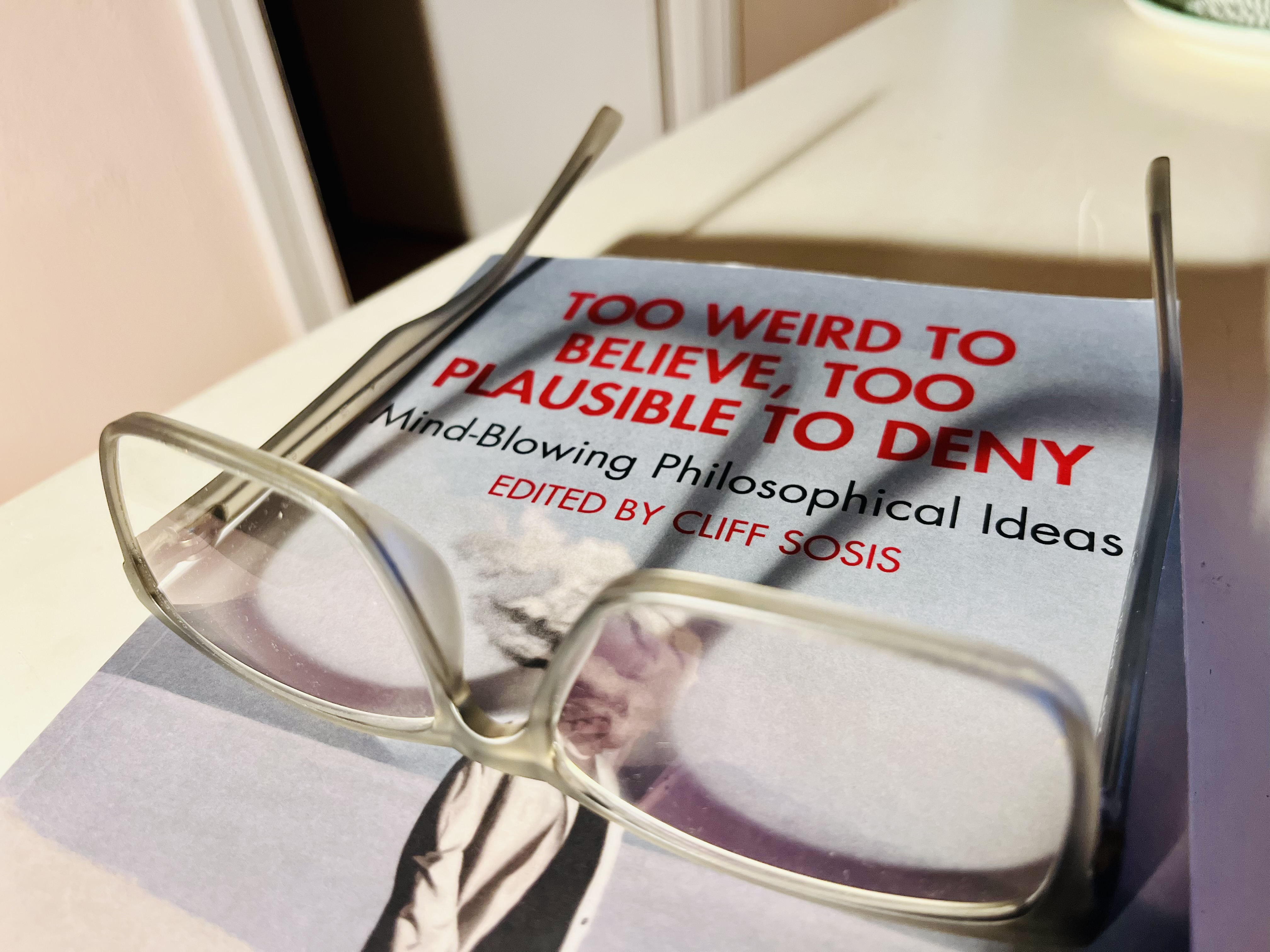



‘Too Weird To Believe, Too Plausible To Deny’ Book Review
One reason I wasn’t really prepared for my philosophy course at university 26 years ago is that I only read two books before heading off to undergraduate study: Descartes’ Meditations and Bertrand Russell’s The Problems of Philosophy. Although Russell’s work should have given me some flavour of the analytical approach, that careful sifting through of concepts and sharpening of definitions that would occupy me in a few months’ time, for some reason I wasn’t ready for how the central concerns of the philosophy of language and the philosophy of mind would be presented in the papers in academic journals that formed our set reading. Perhaps, if I had had the wonderful Too Weird To Believe, Too Plausible To Deny, I would have had a smoother baptism into the weird world of thought experiments and counterintuitive arguments in which so much recent analytic philosophy thrives.
The book consists of 29 chapters covering a vast range of topics from sexual reproduction to moral responsibility, property, art, scientific facts, disability, lying, the authority of the law, and the self. Each one is a compelling presentation of a thesis that strikes us as bizarre or implausible, at least at first blush. All the arguments here present vivid challenges to common sense and are couched in plain language so that the book is accessible to the curious layperson.
The book is also tuned to the concerns of the modern world: there’s no Plato’s theory of Forms here; instead, we have topics like cheating in relationships, the sex versus gender debate and the existence of artificial minds, all matters that we could read about (and argue about) in the daily news cycle. Although many of the major debates in philosophy are covered, many chapters present the arguments in fresh clothes and I was often surprised by the new directions in which some authors steered the discussion. Throughout, arguments for and against a position are presented charitably: the reader is furnished with persuasive reasons why somebody would hold even the most shocking views. What seems “weird to believe” is quickly made “too plausible to deny.”
In the introduction, the volume’s editor Cliff Sosis says that philosophers use arguments, not experiments, to establish their claims. He says that the book’s contributions by academic philosophers frequently “conflict with orthodoxy, challenge the status quo, question our traditions, and undermine what is considered common sense.” In reading it, I was taken back to that first thrill I experienced when I made my first attempts at understanding a philosophy paper, that feeling of being disorientated as the scaffolding of everything you thought to be true was patiently and devastatingly dismantled with argument.
It was in the study of thought experiments that this happened most dramatically. A thought experiment is just a story we tell ourselves that asks us to imagine a hypothetical situation, one that is similar enough to the world we know but with some significant tweaks. Once our reactions to the proposed situation are noted and analysed, the experiment is typically taken to suggest something important about our current concepts or the world we inhabit. Thought experiments are central to philosophy: given that philosophical problems cannot be solved by performing laboratory-style experiments with test tubes and chemicals, thinking about odd situations from the armchair has become a popular—even the dominant— philosophical method.
One example which will be familiar to everyone is presented in the 1999 film The Matrix: imagine a world where everything you see, feel, smell and hear is the result of being fed these experiences via a cable attached to your brain. Instead of sitting here reading this review, your ‘real’ body is actually in a vat of fluid somewhere being harvested by aliens. The premise of the film is ancient: the Chinese philosopher Zhuangzi wondered in the 3rd century BC whether the dream he had apparently woken up from, in which he was a butterfly, showed that he was a man dreaming he was a butterfly or, conversely, whether he was now a butterfly dreaming he was a man. The philosophy gets going once we think through these speculations and try to draw more general conclusions about appearance and reality, about what we can know and doubt. If, the argument goes, we can’t rule out that we’re in a Matrix-like situation, can we claim to know anything about the world around us?
The structure of the chapters is clear and helpful: a seemingly counterintuitive philosophical argument is presented, objections and implications are discussed and then some suggestions for further reading are listed. Part one contains chapters gathered under the question ‘What should we do?’ which deal with ethics, politics and freedom. Part two’s chapters are brought under the question ‘What is true?’ and involve arguments that would fall under the more formal classifications of Metaphysics, Epistemology, the Philosophy of Mind and the Philosophy of Science. Such a format obviously has the undergraduate seminar in mind and the book will be a helpful aid to discussion. In a time of (lamentably) shorter attention spans, when educators are struggling to get their students to read texts, the book’s short and snappy chapters that can be read in under an hour will be a boon for those teaching and learning philosophy, even though there can be no substitute for the challenge of grappling with the texts where these thought experiments and arguments first appeared.
I particularly enjoyed ‘Anything Can Be Art’ by Alex King, the only chapter dedicated to aesthetics. Here, King works through the different definitions of art: is art necessarily beautiful? Does it require a show of skill? Must an artwork represent something? Does it have to communicate something or involve an emotional response? King ends up plumping for a social object definition: art is art because someone says so within certain social conditions under which we accord a special kind of attention to such objects and place them in spaces like museums. There’s one for our friends who scoff at conceptual art!
Also brilliant, in different ways, were Graham Priest’s dialogue on being and nothingness in the last chapter; Felipe de Briard’s discussion about whether we should plug into an ‘experience machine’ that would give us a life of undiluted pleasure; Keith Frankish’s clear presentation of the case for illusionism (the claim that our consciousness is not what it seems); the surprising and convincing defence of some forms of bias by Louise Antony (benign bias usefully filters and classifies a messy world); David B. Wong’s reflections on a sensible, defensible moral relativism; Adam D. Moore’s controversial chapter arguing that there is no justification for states to tax their citizens and Carrie Jenkins’ surprising piece on polyamory and cheating which challenges normative assumptions about monogamy.
In a world where we are under the influence of malign political manipulators online, the book’s mission to challenge ‘hidden biases and cherished beliefs’ is salutary. It is a familiar thought, but one still worth repeating, that developing a critical, questioning mind is vital if one is to navigate the complexities of our politically volatile societies. The duty to develop such a questioning attitude to what we hear and read is linked to our duty to become informed citizens who take seriously our responsibilities as participants in a democracy. Philosophy gives us the tools, and books like these reinforce their use, to subject the claims of political actors, advertising moguls and AI boosters to scrutiny: what do they really mean by x? Doesn’t what they said yesterday conflict with what they’re promising for tomorrow? What reasons have they offered in support of this policy? Are they good reasons? In this light, an abstract discipline that asks seemingly intractable questions like whether numbers exist or whether we have a persisting self suddenly becomes crucially relevant. But this makes it sound like I’m only recommending the dive into philosophy that this book would be a companion to because of its effects on our engagement with the world. Philosophy, apart from giving us the tools to question and resist easy answers, is fascinating and rewarding in itself. It is difficult and rich as a purely intellectual pursuit, and, 26 years on, I’m still hooked.