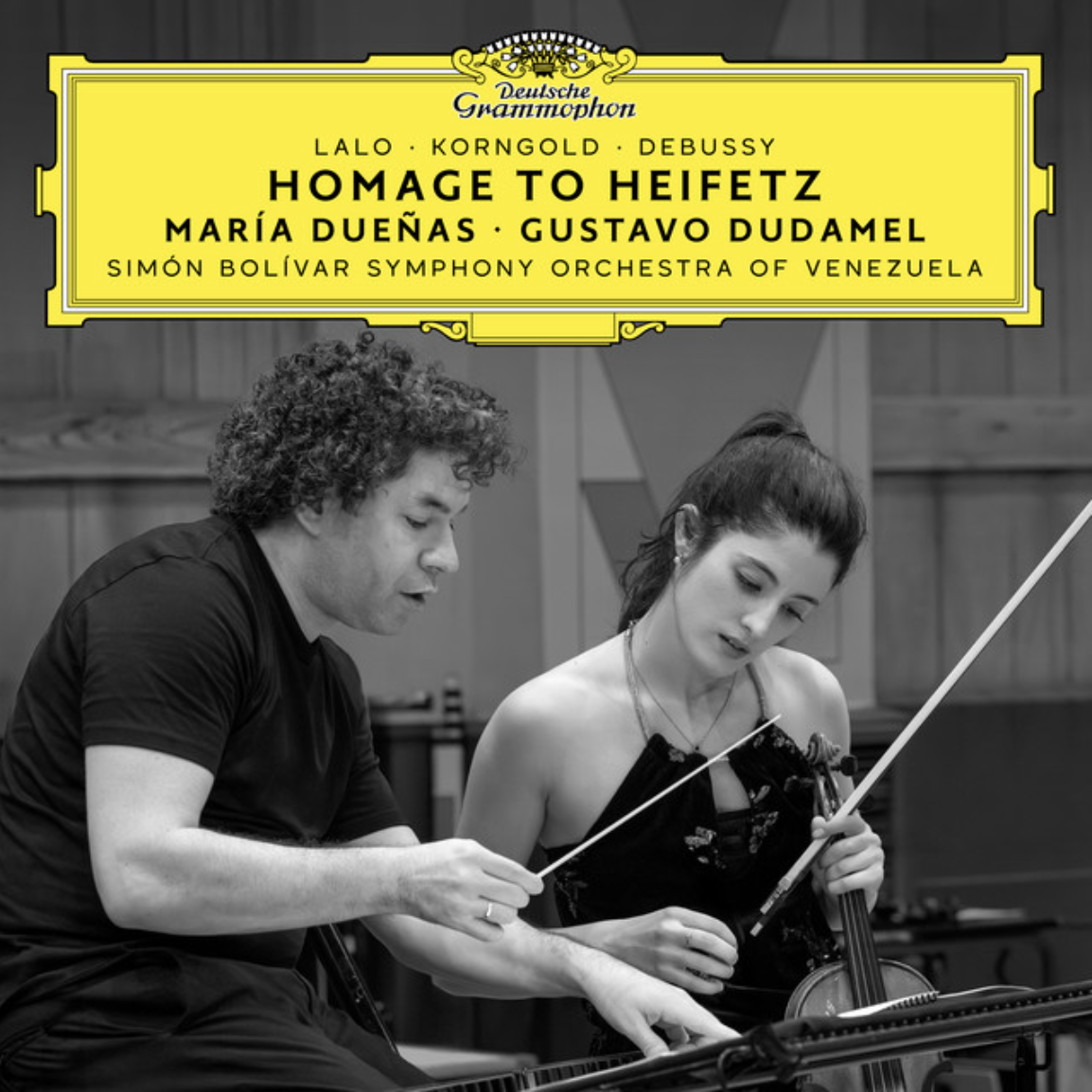



What I’m Listening To… ‘Homage to Heifetz’ by María Dueñas and Gustavo Dudamel
This disc, released at the end of August, is dominated by two violinists: the first is, most obviously, the soloist María Dueñas—a 23-year-old from Granada, Spain, who is Gramophone magazine’s Young Artist of the Year and a BBC New Generation Artist (2021-2023) with an exclusive recording contract with the classical music giant Deutsche Grammophon. The second hovers in the background as guide and inspiration and that’s Jascha Heifetz (1901-1987), a Russian-American violinist who many consider one of the greatest violinists of all time.
Dueñas, accompanied by the Simón Bolívar Symphony Orchestra (conducted by Gustavo Dudamel), takes various paths towards a tribute to Heifetz. Firstly, the coupling of Lalo’s Symphonie espagnole and Korngold’s Violin Concerto replicates the same coupling recorded by Heifetz in 1953. Secondly, Dueñas plays Heifetz’s violin, a 1731 Stradivari violin she borrows for the piano accompanied pieces. Thirdly, and here we require more freedom of interpretation than the two concrete facts above, the Spanish violinist plays with a similarly rich, warm and emotional tone as her inspiration.
So how does this heap of Heifetz-linked music fare after a few listens? Let’s start with the Lalo, a prime example of French composers’ obsession with the sounds and spirit of Spain. I admit I’ve always been slightly prejudiced against this work, regarding it as all fireworks and little substance. Dueñas and Dudamel should naturally feel at home in this Latin music and they make a good case for Lalo’s ultra-passionate excess with the Venezuelan Simón Bolívar Symphony Orchestra launching into the music with a certain raw verve—of course, ‘raw verve’ for some listeners may be taken as a lack of polish by others.
In the second movement, the woodwinds are well foregrounded and Dueñas is good at conveying the swagger of this work but there’s a vague sense that the soloist is too forward in the recording, upsetting the balance between orchestra and violin.
Lalo’s work has been recorded by practically every famous violinist so competition is tough. As a comparison, Barenboim and Perlman in their 1981 recording with the Orchestre de Paris achieve a slightly lighter and more dance-like texture in the third movement. Listening side by side, it’s a shame that Dueñas and Dudamel come across as positively plodding by contrast.
The emotional core of the work, the fourth movement Andante, coaxes soloist and orchestra to collaborate fluidly. Heifetz’s own 1953 rendition, however, proceeds at a brisker pace than Dueñas’ without sacrificing melancholy and tenderness. Again, many of these differences are just valid interpretative liberties; listeners will decide which approach they prefer or whether they want to embrace multiple ways to realise these works which is why we invest in rival recordings in the first place. With the final movement, which contains the most recognisable tune from the entire work, Dueñas displays a surefooted tone.
Now, if I’m ambivalent or cool towards the Lalo, the Korngold is another matter altogether; that magical opening, that lush combination of heart-on-sleeve late Romanticism with a whiff of Hollywood, the way the music seems to hold back only to prepare for another outpouring of feeling. Dueñas’ interpretation is mellow and tinged with sadness and she invests the music of the slow movement with such an intensity of feeling that I was encouraged to pay attention to every detail. The finale was suitably puckish, too.
Despite a thoroughly committed performance, the top choice in this repertoire remains Gil Shaham with André Previn, and the London Symphony Orchestra—not only do they enjoy a more spacious acoustic profile but the LSO is a silkier ensemble than Dudamel’s.
Toward the end of the album, we have three Debussy arrangements and one of Heifetz’s favourite encores ‘Estrellita’ by Manuel Ponce, arranged by Heifetz. The transcriptions are more than album fillers—they are unusual and interesting in their own right. Itmar Goldman is the pianist for three of the arrangements.
Unashamedly using plenty of vibrato, Dueñas’ approach is traditional and harks back to the golden age of the violinists from the middle of the last century which is fitting, of course, given that the album is a homage to one of the greats. Beyond the eye-catching novelty of this tribute, there is serious playing here and Dueñas’ blistering talent will be worth following in the coming years. Let’s hope this album’s artist-dominated cover and fancy marketing can get this essential music to younger ears. For more seasoned listeners, by bringing something of Heifetz’s spirit into the 21st century, this disc should encourage us to go back and dig into the catalogue to rediscover his landmark performances. With just a few reservations about balance and orchestral polish, this is as good an introduction to these works as any with the added bonus of some rarely heard extras.