

Unite To Ballot Members On Public Sector Pay Proposal
Unite has announced that members will be balloted on the first five years of the proposed public sector pay agreement announced in the 2026 Budget.
Unite has announced that members will be balloted on the first five years of the proposed public sector pay agreement announced in the 2026 Budget.
A statement from Unite follows below:
Further to the “Budget 2026 – Public Sector Pay” electronic mail out to all members on Budget Day, this is the pay bulletin being issued by Unite in advance of the ballot of all members on the pay proposal.
The elected, Unite Public Sector Pay Working Group met on Wednesday 8th July to discuss the Budget and specifically public sector pay and crucially it was agreed that the union would ballot on the first element of the pay proposal only. So the five-year proposal from 2026/27 to 2030/31 and not the second element proposed to run from 2031/32 to 2035/36. A further ballot of members will be undertaken in 2031 on whether Unite members working in the public sector at that time accept the further five year pay arrangements.
The rationale for this decision is that we do not know what the economic environment will be in 2031 including IRP and IRP forecasts for the following five years. The Unite membership in the public sector in 2031 will also look very different, with many current members no longer working in the public sector and many new entrants to the public sector being Unite members in 2031. So that second vote will be a refresh of the mandate, reaffirmation of the proposal or we might want/need to pursue additional elements as part of the second half of the pay proposal.
Moratorium/Negotiation Process/Higher Earners
In the Budget Day mailing, it was indicated that Unite had not agreed a moratorium on departmental or sectoral claims as was suggested in the Budget address. HMGOG have acknowledged and agreed that Unite have provided no undertaking as to a moratorium. As previously articulated Unite’s priority is to see available monies directed into public sector pay, which is consolidated, pensionable and permanent. However where there are departmental or sectoral claims that are meritorious and well-founded the union will continue to pursue these on behalf of members. HMGOG of course reserves the right to reject such claims, very much as is the current rhythm of industrial relations.
There have been further exchanges around the nature of the negotiation process and whether the spirit and the letter of the Unite Dispute Resolution Agreement from 2025 have been met. It is Unite’s view that the negotiation process has fallen short of these expectations. However as indicated in the Budget Day mailing, the level of engagement has been a marked improvement on previous years and it is pleasing that several of Unite’s
proposals presented through the negotiation process have formed part of the final proposal announced at Budget by the Chief Minister.
Also as articulated in the Budget Day mail out, Unite had accepted the differential treatment at £100k+ conditional on a proposal made by the union, which HMGOG have now confirmed in principle is agreed and we have already started the process of engaging with our shop stewards and members in this category.
Minimum Entry Salary
We are awaiting the exact mechanics of how this element will operate. We would anticipate that each August once the public sector pay increase is applied an exercise will be undertaken to look back to the preceding 1st April to 31st July. Any underpayment for members identified versus the UK minimum would result in a backpay adjustment to be made. It is anticipated that the minimum entry salary in the UK as at 1st April 2026 will be £25,614.
The minimum entry salary matching position with the UK has been an issue that Unite has been pushing hard for and it is pleasing that in addition to the agreement signed between Unite & HMGOG for 2025/26 that this is now a permanent fixture. The reality is that most likely as Gibraltar pay increases will outstrip UK increases that the gap at the 1st April each year when the UK increase is applied will reduce year on year.
Annual Leave
On the additional two days of annual leave on attainment of 15 years service, again we are awaiting clarification on when this will apply and to whom, for example those that will reach 15 years service later this year. Additional annual leave was a key component of the union’s pay claim so the increase for longer serving public sector workers is welcomed; however Unite will continue to seek improvements in leave entitlement across the board to improve work/life balance for all public sector workers.
Superannuation Cap/Pensionability of Allowances
The union has long sought an increase to the cap on when contributions from the employer and employee to the Superannuation Fund cease. Allowances to be pensionable is also a key area given that sizeable proportions of income are derived from allowances. The Chief Minister has announced that a Working Party will be set up between HMGOG and the Joint Unions to include Unite to explore these areas. Members will be kept updated.
Weighted Average on Real Terms Loss in Pay
There were numerous discussions around the actual figure on real terms losses in pay given that the statistics can be cut in different ways, different figures can be utilised to achieve different outcomes. The real terms loss in pay since August 2019 to August 2025 will of course differ dependent on salary given the banded nature of pay increases in previous years and indeed pay freezes at some pay bands. In light of the varied nature of real terms losses
in pay and to simplify an approach to the pay solution to address the recovery meant that a weighted average approach was adopted which meant looking across the real terms losses per salary band and then landing on the average of 12.6%.
Public Sector Pay 2026/27 to 2030/31
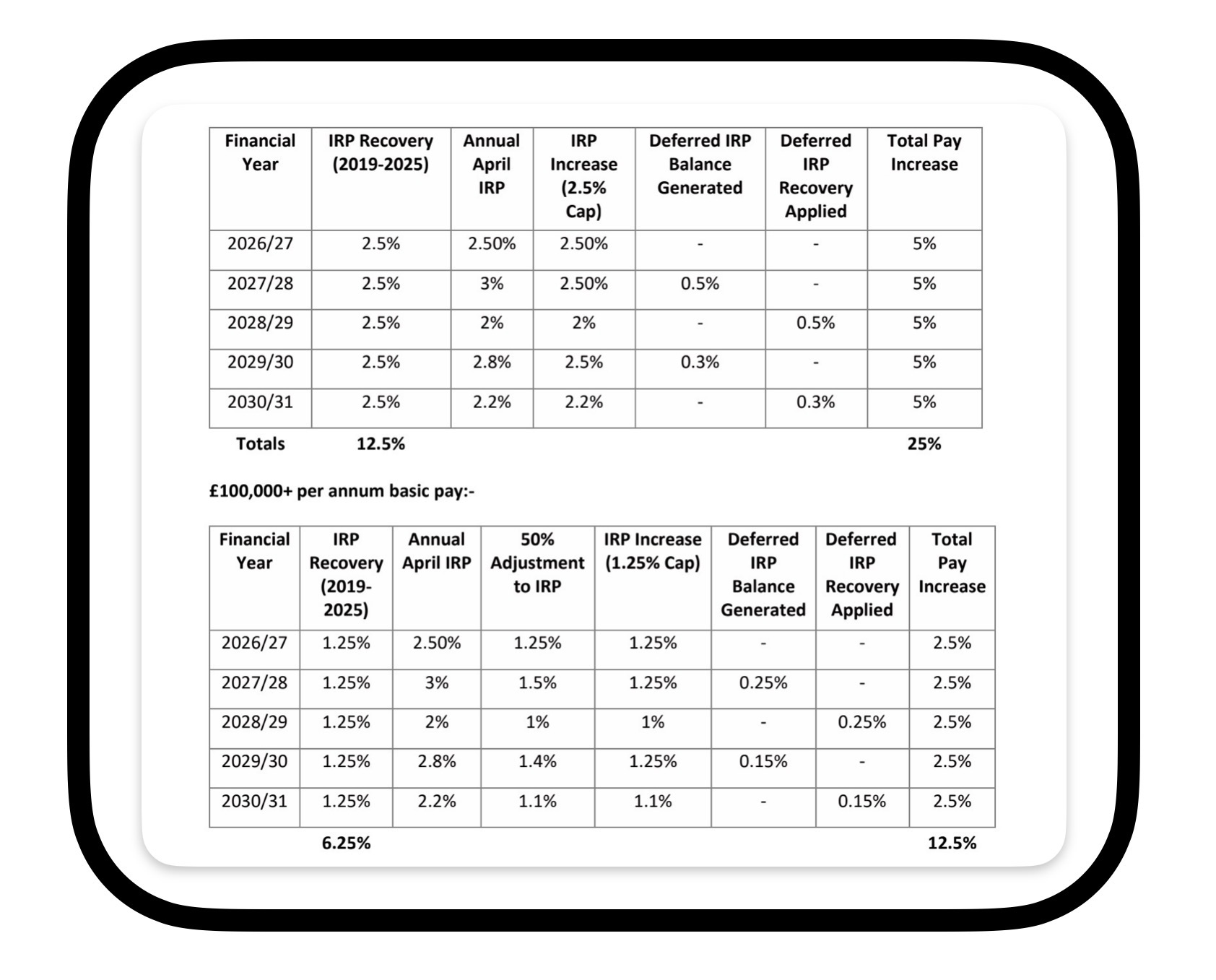
The proposal on pay for the next five years is that pay for those earning up to £100,000 will increase by 2.5% annually plus the April IRP figure capped at 2.5%. For those earning £100,000 or more, those figures would be 50%, so an annual increase of 1.25% plus 50% of IRP with a cap of 1.25% so a maximum increase of 2.5% per annum. Both formulas have recovery mechanisms in place where IRP is above 2.5% in a given year.
To provide this in an illustrative format, tables have been produced below mapping out what the pay formula could look like across the next five years, but clearly this is hypothetical as we do not know exactly what IRP will be in coming years and the examples used are deliberately smoothed out for the ease of presentation:-
Up to £100,000 per annum basic pay:-
Public Sector Pay 2031/32 to 2035/36
Whilst the position on 2026/27 to 2030/31 was discussed extensively with the Joint Unions in negotiations, there were cursory discussions around 2031/32 and beyond, but no real detail. As previously detailed Unite is not balloting on this element and will not until 2031. The proposed position from HMGOG for 2031/32 to 2035/36 is an annual pay increase of IRP+1% up to a maximum of 4%.
It is unclear at this stage whether there would be any carryover as with the model for the first five years, so if IRP+1% was 4.5% would there be a 0.5% carryover to a future year to be paid when IRP was lower? The union has also sought assurances and confirmation that the 2031/32 to 2035/36 proposal will be paid to all and in full regardless of earnings. The union awaits further dialogue on these points and members will be updated once we have clarity, but as stated we are not balloting on this element at this time.
Workplace Visits/Ballot Arrangements
Unite will be undertaking a series of workplace visits in advance of the ballot opening to speak with members, to discuss the pay proposal and answer any question or queries. It will also be an opportunity for members to “Update Their Details” so as we have e-mail addresses or mobile numbers for the E-Ballot. We have a short window so will not be able to visit every workplace, but will visit as many workplaces as possible. If your workplace wants a Unite visit please contact the union at Membership.Gibraltar@unitetheunion.org and we will facilitate that visit.
The current proposed ballot timetable is:-
Electronic Ballot Opens – Thursday 16th July
Electronic Ballot Closes – Midnight Sunday 26th July
Physical Ballot at the Unite Office Opens – Monday 27th July
Physical Ballot at the Unite Office Closes – 4pm Thursday 30th July
The proposed ballot will enable the majority of members to vote electronically via e-mail or text, then there will be the opportunity to vote physically in the ballot in the office. The closing date of the ballot also provides that we have a ballot outcome in advance of the pay settlement date of 1st August. The ballot outcome will be advised to members.
The proposal that has been presented at Budget 2026 represents the potential end of a long road dating back to the dispute in 2025 and the Dispute Resolution Agreement that members voted in favour of. Unite have pursued the terms of that agreement since September 2025.
Members will now decide whether to accept the pay proposal for 2026/27 to 2030/31.
