


Exploring Artworks: Mario Finlayson’s ‘Enigma’
YGTV starts a new series today. Over the next few months we’ll be closely analysing artworks that are on display in Gibraltar’s various galleries. We’ll be providing background information and seeking the input of other artists in order to understand and interpret the works featured. The series is motivated by the belief that, when entering a gallery, it is a deeply enriching experience to pause and reflect on the paintings, sculptures and installations that we see, rather than conducting an express, superficial tour from piece to piece.
Today we look at ‘Enigma’ by Mario Finlayson, who is often referred to as the doyen of local artists. He was born in Gibraltar in 1927 and passed away in 2020. Finlayson studied art at the Slade School of Fine Arts, obtained an Art teacher’s certificate in Bristol and also studied at Goldsmiths College, University of London. He returned to Gibraltar and later became the head of the Art department at the Girls’ Comprehensive School. He ran Gibraltar Arts Centre in Prince Edward’s Road for over 30 years and exhibited works in Spain, London and Germany. Finlayson’s works received many awards, prizes and honours and, in 2015, the Gibraltar National Gallery was named in his honour.
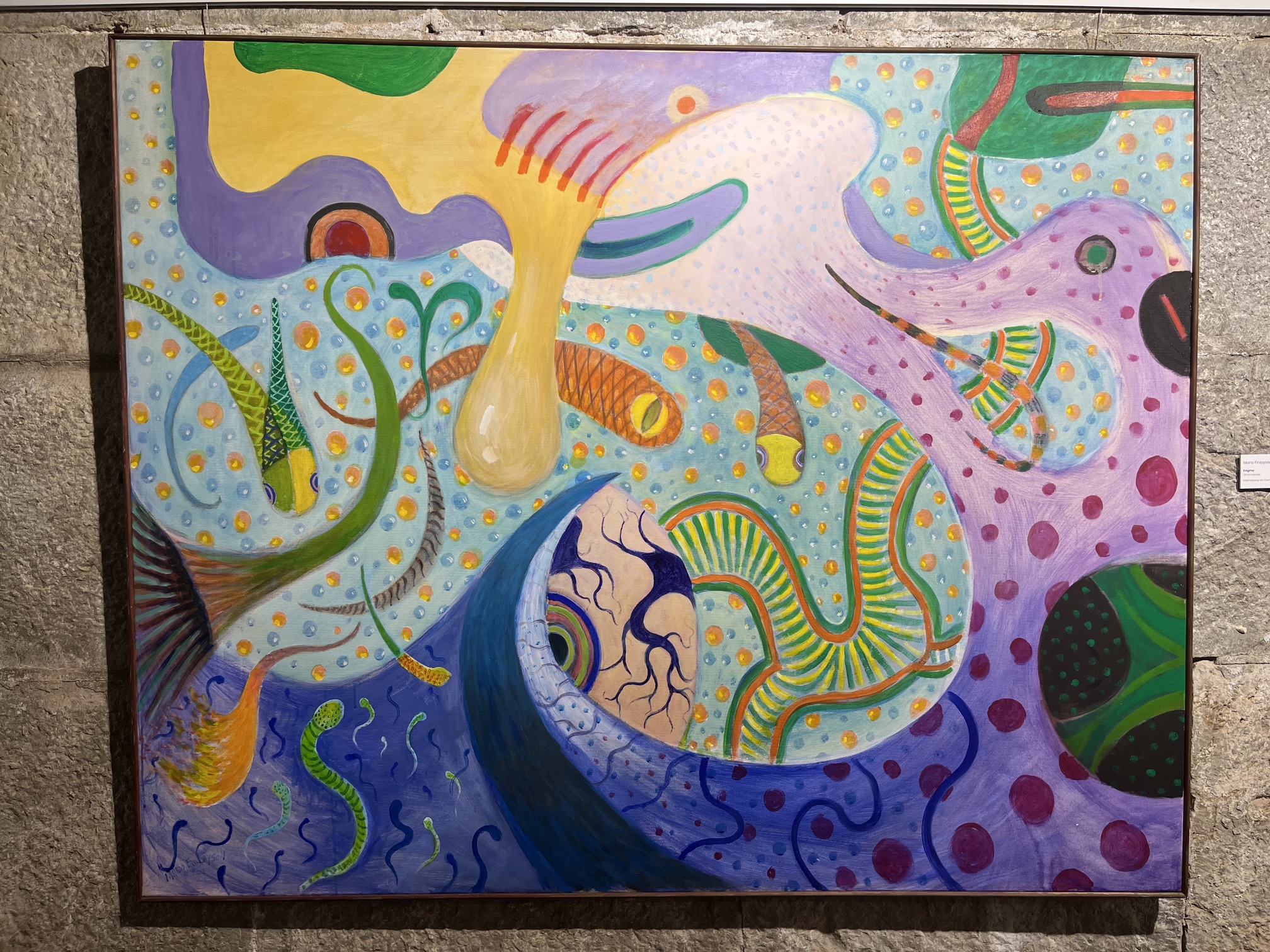
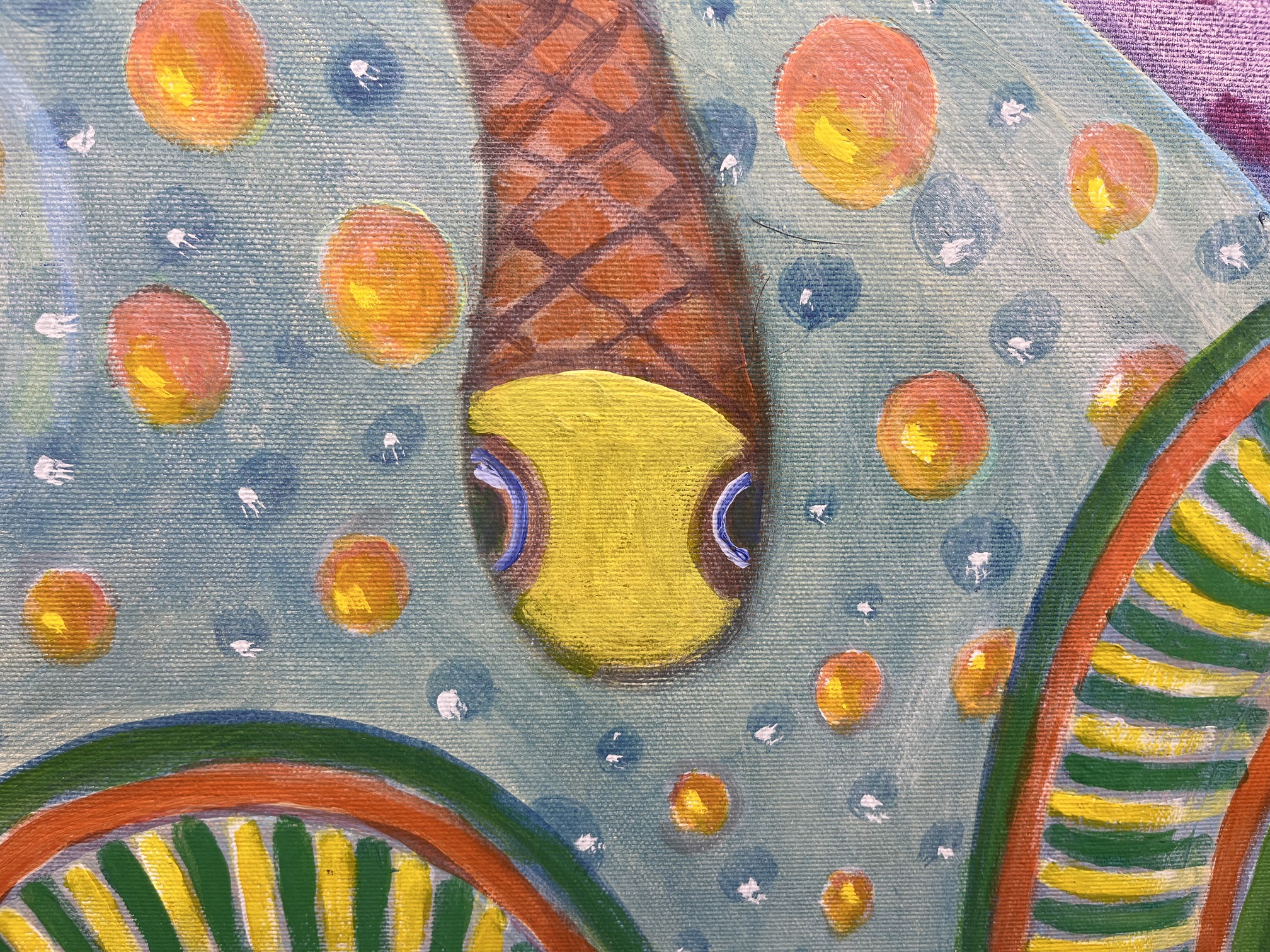
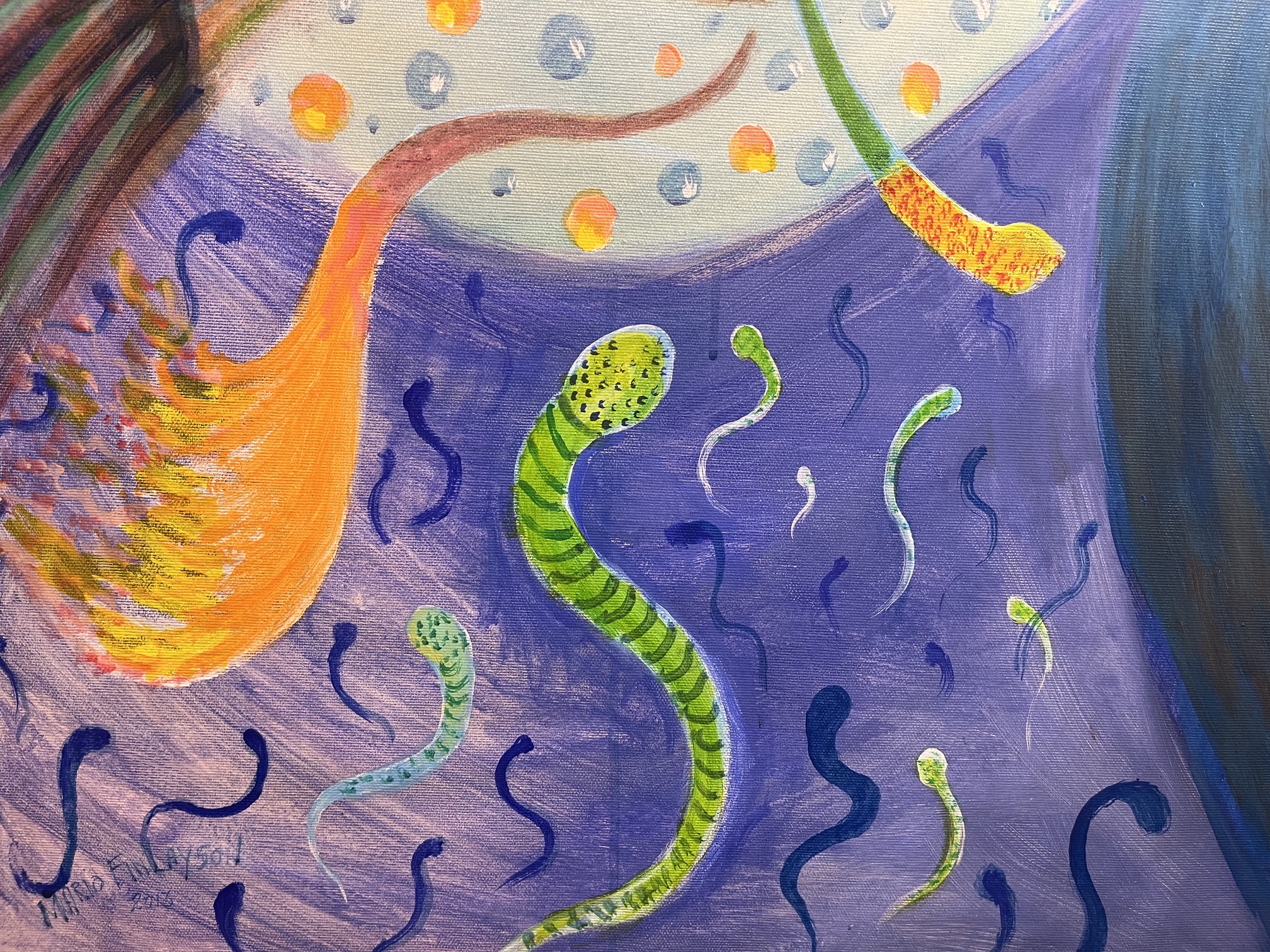
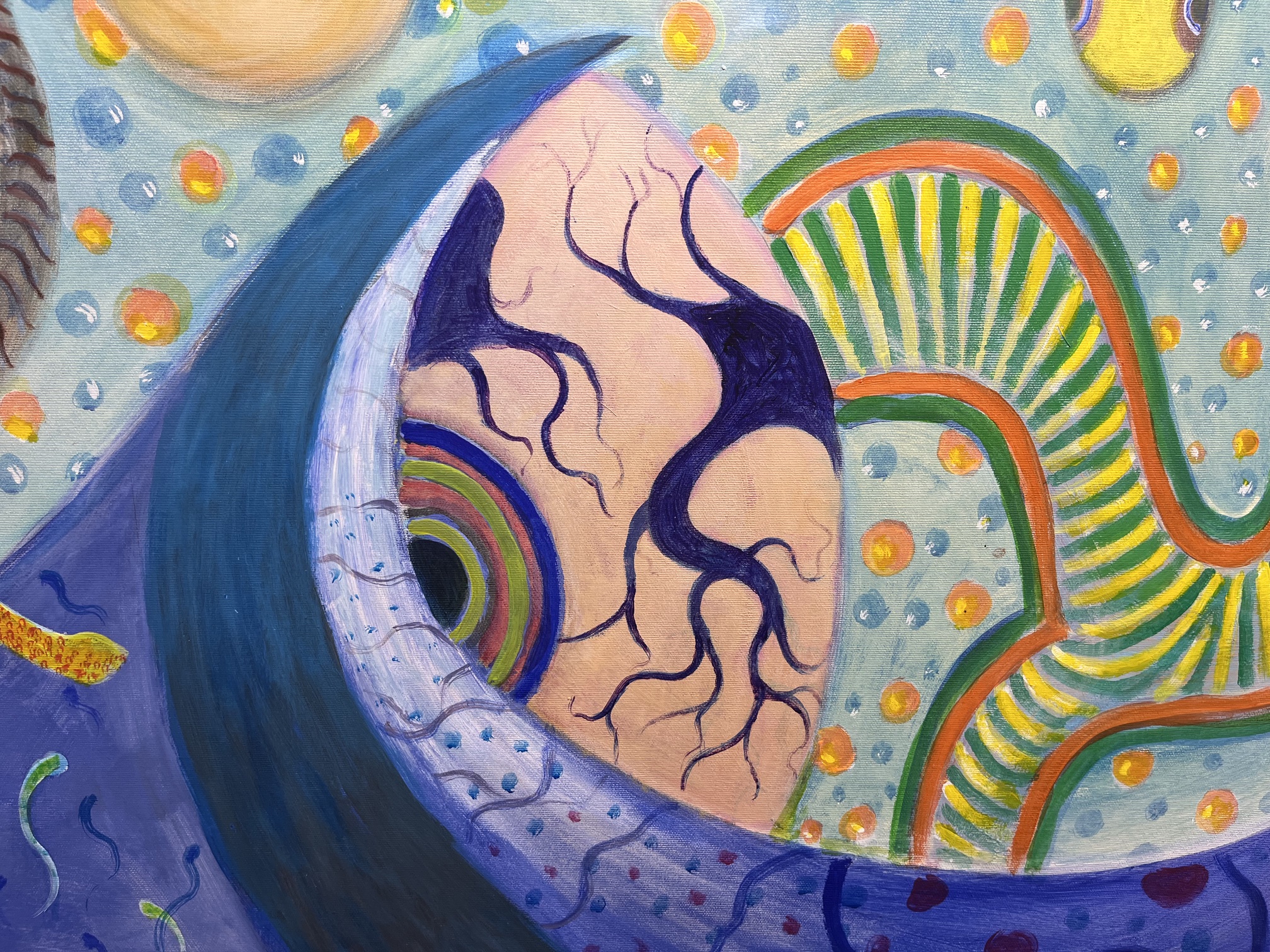
‘Enigma’, which won the first prize at the 2009 36th International Art Exhibition, presents an alien world: strange, worm-like creatures pop out from vividly coloured swirls and waves. On the left, organisms strongly resembling sperm swim about. Dominating the centre of the piece is what appears to be a large, menacing eye with veins. A ribbed channel that bifurcates to the right of the ‘eye’ reminds us of arteries, fallopian tubes or the gut. We seem to have been granted a glimpse through a microscope of the mystery of the origin of life unfolding. However, although the scale is microscopic, there is also a strong resemblance between the forms and colours of these cells and body parts and the much larger scale of heavenly bodies like stars and galaxies. The work can therefore be interpreted as drawing our curiosity towards the tiniest origins of life, the sex cells involved in conception, and the ultimate origins of life in the Big Bang and formation of galaxies and solar systems. (See close up photos below)
Although its title seems to point to the viewer’s own sense of puzzlement when confronting the work, one thing is sure: ‘Enigma’ represented a radical departure from the artist’s self-portraits and rooftops, subjects that Finlayson was usually known for.
Artist Lorraine Buhagiar says she remembers the painting very well: “I saw it in a competitive exhibition setting and, at first glance, I didn’t recognise it as Mario’s work; I thought it might have been the work of a young artist. The title doesn’t give much away which makes it open to interpretation but I immediately felt it was portraying some kind of journey, conception, birth or maybe rebirth, definitely a joyous piece.”
She says that both the palette and execution of ‘Enigma’ “immediately captured” her attention and, once she discovered it was a work by Finlayson, she was “intrigued.”
“On reflection, it says a lot about the artist: experimental, adventurous and enthusiastic,” she adds.
Although recognising that this piece is a departure from the artist’s familiar works and what we had come to expect, she thinks it is also “typical of him to have surprised us with ‘Enigma’.”
“He was always learning and inspiring others and had so much enthusiasm for art which was infectious. I would say that the style and content of this painting probably reflects the freedom Mario was experiencing at that moment in time, as he continued to experiment and practice his craft,” she concludes.
For Stefano Blanca Sciacaluga of Kitchen Studios, it is Mario’s playfulness that comes through: “The piece is not only enigmatic but also playful and to a certain extent infantile in its use of colours and shape and a distinct form of expression. This piece really gets the imagination going and serves as inspiration to not take one’s work too seriously.”
He argues that the abstract nature of the piece “lives up to its name, and asks two questions: ‘what?’, as in what is it? and ‘why’? in comparison to other pieces by the same artist. It leaves a lot more openness to interpretation than we are accustomed to from this artist.”
Asked about the painting’s break with the artist’s customary style, Stefano says: “Many artists get ingrained in a certain style, it makes their work recognisable, but art is also often about pushing the boundaries of creativity, which is certainly what Mario Finlayson is leaning into here, moving away from his more well-known landscapes, in particular his rooftops, to give us something which could be considered a polar opposite. This is not to say that his usual work isn’t playful in nature, in the use of a colourful palette, for example. There is recognisability and enigma all at once in this particular piece.”
We also reached out to Mario Finlayson’s daughter, dance teacher Paulette Finlayson. She says that her father, in this piece, “emphasises the importance of bringing the viewer close in to what seems to be an enlarged view through a microscope or certainly a view of some species.”
She continues: “I believe what is rather striking in terms of the subject matter and having painted this at age 82 it certainly highlights his constant observation and questioning of the human condition and evolution. Mario would always be fascinated by science and exploration and I believe that, as he grew older, he became more interested in these subjects and questions.”
On the change of style and subject matter she says: “It’s a total move away from rooftops and figurative subject matter to a contrasting approach in the context. There is a fascination here with where we come from and where we are going. Despite this thought, I believe he was always experimenting and he would be happy for the onlooker to feel or interpret the piece themselves.”
Finally, we spoke to artist Shane Dalmedo who works at the GEMA gallery where the painting is currently on display.
She recalls Finlayson’s enthusiasm: “He was always very excited and he was always trying something new and experimenting—he applied sand to the canvas in some paintings to give it a texture.”
In ‘Enigma’, she says, “there are circles and waves and even something that looks like a lava lamp. You can interpret parts as being alive or being cells; the spark of life is here.”
She recalls that when he won the first prize with this work, the judge thought it had been painted by a younger painting “because it is a very energetic painting.”
YGTV’s series continues with Elio Cruz’s ‘Portobello Table One.’