


What I’m Listening To…‘Ex contrario’ and other works by Giya Kancheli
Contemporary classical music can be a forbidding territory for the uninitiated listener to explore: many of the composers who have produced the important works of the last 30 years are not household names and their music is often difficult to understand, devoid of obvious emotional content and full of dissonance. Like much contemporary art, the intellectual or conceptual content of the work seems to trump any enjoyment that even patient and well-informed members of the public might hope to draw from it.
Contemporary classical music can be a forbidding territory for the uninitiated listener to explore: many of the composers who have produced the important works of the last 30 years are not household names and their music is often difficult to understand, devoid of obvious emotional content and full of dissonance. Like much contemporary art, the intellectual or conceptual content of the work seems to trump any enjoyment that even patient and well-informed members of the public might hope to draw from it.
One counterexample to this admittedly simplistic picture of modern music is the work of the Georgian composer Giya Kancheli (1935 – 2019) whose music combines avant garde techniques with a solid emotional and lyrical core. Born in Soviet-era Georgia, he later moved to Berlin and Antwerp following the collapse of the USSR in 1991. Once the Soviet regime softened in the 1980s, his work gained a wider audience helped by commissions and world premieres by American soloists and orchestras.
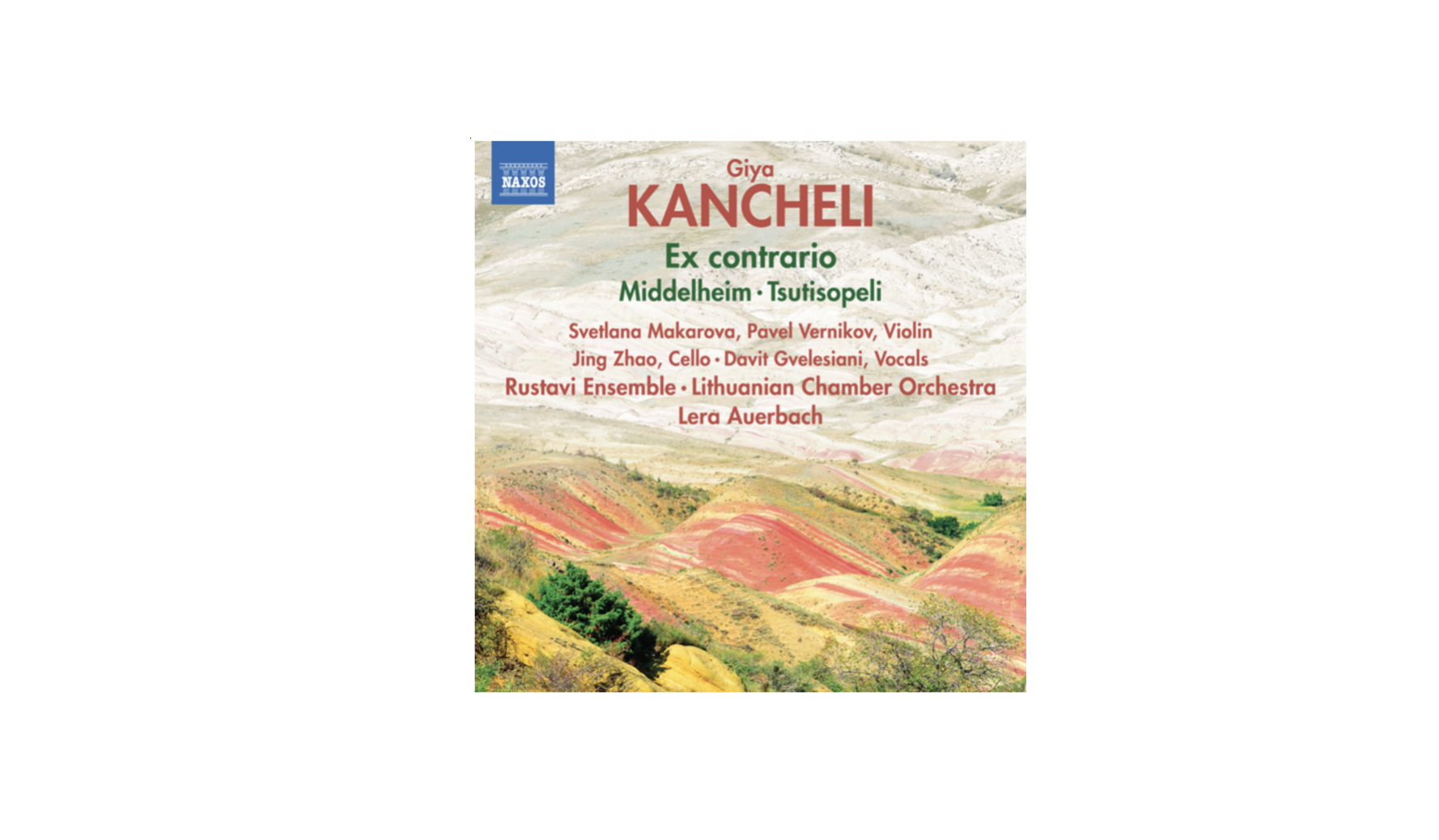
This album, released in April this year by the budget classical label Naxos (never afraid to invest in obscure music), brings together three works. The longest and most substantial piece is ‘Ex contrario’ (2006) which is performed in its version for two violins, a string orchestra and a keyboard sampler. ‘Middelheim’ (2016/18)—for piano trio and orchestra—clocks in at around 21 minutes and the final work, ‘Tsutisopeli’ (2019) is for two violins, and a men’s choir. Featuring the Lithuanian Chamber Orchestra conducted by Lera Auerbach, all three are world premiere recordings for these particular arrangements.
To enter Kancheli’s musical world is to become acquainted with the power of unsettling contrasts. Lugubrious strings and alarming string interruptions will suddenly yield to music of a startling beauty and lyrical calm; the modern and the romantic existing side by side in an uneasy marriage.
‘Ex contrario’ is typical of Kancheli’s late work. There is a sense of foreboding with the static music of the strings which leads to a remarkably lyrical section tinged with sadness at around the two minute mark. An angrier and more turbulent section, with both solo violins arguing with each other ensues and some pizzicato work leads to another calmer interlude. It’s important to stress that there is nothing ‘light’ or facile about Kancheli’s lyrical breathers—flanked as they are by unsettled music, these emotionally more satisfying sections always seem fragile and provisional as the listener knows that they will soon be sabotaged by more despair. Half way through the piece there is a film music-like climax followed by drone effects from the tanpura, a four-stringed Indian instrument, introducing the folk music element so crucial to Kancheli’s identity as a composer. The work concludes with the gentle theme we have come to long for, now leading to plucked strings and silence. I say ‘concludes’ but what we have heard is more a series of episodes than a structured argument—still, it is a compelling work.
The sound quality is exemplary—little to no background noise and a very vivid presentation of the soloists in a spacious acoustic.
The next work, ‘Middelheim’, is for piano trio and orchestra. The Naxos liner notes, which are characteristically comprehensive, suggest that title probably refers to the Middelheim Open Air Sculpture Museum in Antwerp, where the composer spent the last part of his life. The work starts with a stark, three note theme on piano, echoed by the strings. Once again, this disconcerting atmosphere gives way to a gentle, dance-like theme which the violin comments on. Although scored for a piano trio, the three instruments play very much in isolation from each other. At the midpoint, there is a moment of tension with string glissandos.
There’s a change of mood with ‘Tsutisopeli’, the last work on the album, which sets a traditional Georgian traditional poem about the brevity of life, a subject all the more poignant as it was one of Kancheli’s final works. Here the music is more overtly liturgical, with an Eastern Orthodox-like chant background by the Rustavi Ensemble accompanying Davit Gvelesiani. This is music possessing a bleak beauty with Kancheli’s characteristic use of folk music emerging in the form of a violin interlude.
I have no reservations at all about the quality of these performances. Although facing little competition, the ensembles deliver committed renditions of these works.
Kancheli’s music grows from contrasts. One might— somewhat uncharitably—accuse him of working to a formula of alternating desolate sections with meltingly lyrical parts but his method is more profound. His ability to craft wispy themes that seem to come from another world, themes that are disarming in their simplicity, and then placing them alongside more harrowing parts that leave you hankering after the return of those themes, is no mere trick to be repeated ad nauseam. Instead, it seems to uncover something profound by showing that the lyrical only has the power it assumes over us because it is about to be destroyed—in his world of unpredictable outbursts, we cannot settle into any sense of calm or quiet.
Kancheli’s music pushes us to reject any previous notions about whether music ought to have a satisfying emotional plan—it is therefore music which is uniquely suited to the modern world. At once accessible and emotionally ambiguous, this album is the perfect entry point into the thrill of contemporary classical music.
About this series: In this series, we’re going to live with an album for a week. I’ll listen to it on repeat as I walk up town, do shopping and wait for my daughter. I’ll let it all sink in so it becomes the soundtrack of my days…and then I’ll write about it. Expect variety: I’m passionate about classical and jazz but will also be revisiting my favourite albums from the last 50 years from the Doors to Suede and even new releases. Hopefully, with affordable streaming services, you’ll do the same and encounter unfamiliar music you will grow to love, or disagree with, or simply ignore.