
Cádiz Researcher Explores Gibraltar’s Multilingual Identity

A sociolinguist from Cádiz, Francisco Javier Fonseca Rengel, is researching the complex relationship between language, culture, and identity in Gibraltar as part of his PhD at the University of Cádiz (UCA).
Mr Fonseca completed a degree in French and English Studies at UCA before achieving a Master’s in Sociolinguistics from the University of Amsterdam. At the end of 2022, upon returning to Cádiz, he decided to enrol in the PhD Programme in Linguistics at the university, engaging in research that focuses on the contact between different languages and cultures.
He expands: “It was at this point that the opportunity to research Gibraltar arose, given its multilingual and multicultural context.”
Several professors at the UCA had already conducted sociolinguistic research on Gibraltar, including Dr. David Levey and Dr. Luis Escoriza, who are the two co-directors of his PhD thesis. “I therefore seized the opportunity to continue the long-standing tradition of studying the Gibraltarian community through a sociolinguistic lens at the UCA,” he says.
His doctoral research focuses on Gibraltar’s linguistic and semiotic landscape via a study of the visible presence of languages and cultural symbols in public spaces.
Mr Fonseca expands: “The term linguistic landscape refers to the written and visible use of languages in the public spaces of a multilingual territory. It is important to note that this definition differs from another common use of the term in English, which refers to the overall language situation of a territory. The term semiotic landscape, on the other hand, refers to the visible presence of non-linguistic items (such as flags, colours, images, and cultural symbols) in public spaces, which convey particular meanings in relation to the context in which they are displayed.”
His work examines how English, Spanish, and Llanito appear in Gibraltar’s streets, signs, and advertisements, and how these reflect broader questions of identity, heritage, and language policy.
“From a politico-linguistic perspective, the main goal is to examine to what extent English, Spanish, and Llanito are used in public spaces. In this context, the more a language appears in the urban environment, the higher its perceived social status and vitality, both of which are shaped by past and recent language policies in a multilingual country like Gibraltar,” he adds.
The PhD researcher says he has become fascinated by the Rock and its inhabitants: “From a personal perspective, as a Gaditano and given the geographical proximity, as well as my lifelong interest in languages and cultures, I have always been intrigued by Gibraltar and the Llanitos. However, it was not until I began reading extensively about the territory’s languages, history, the evolution of its population under British sovereignty, and multicultural makeup that I became truly fascinated by the Rock.”
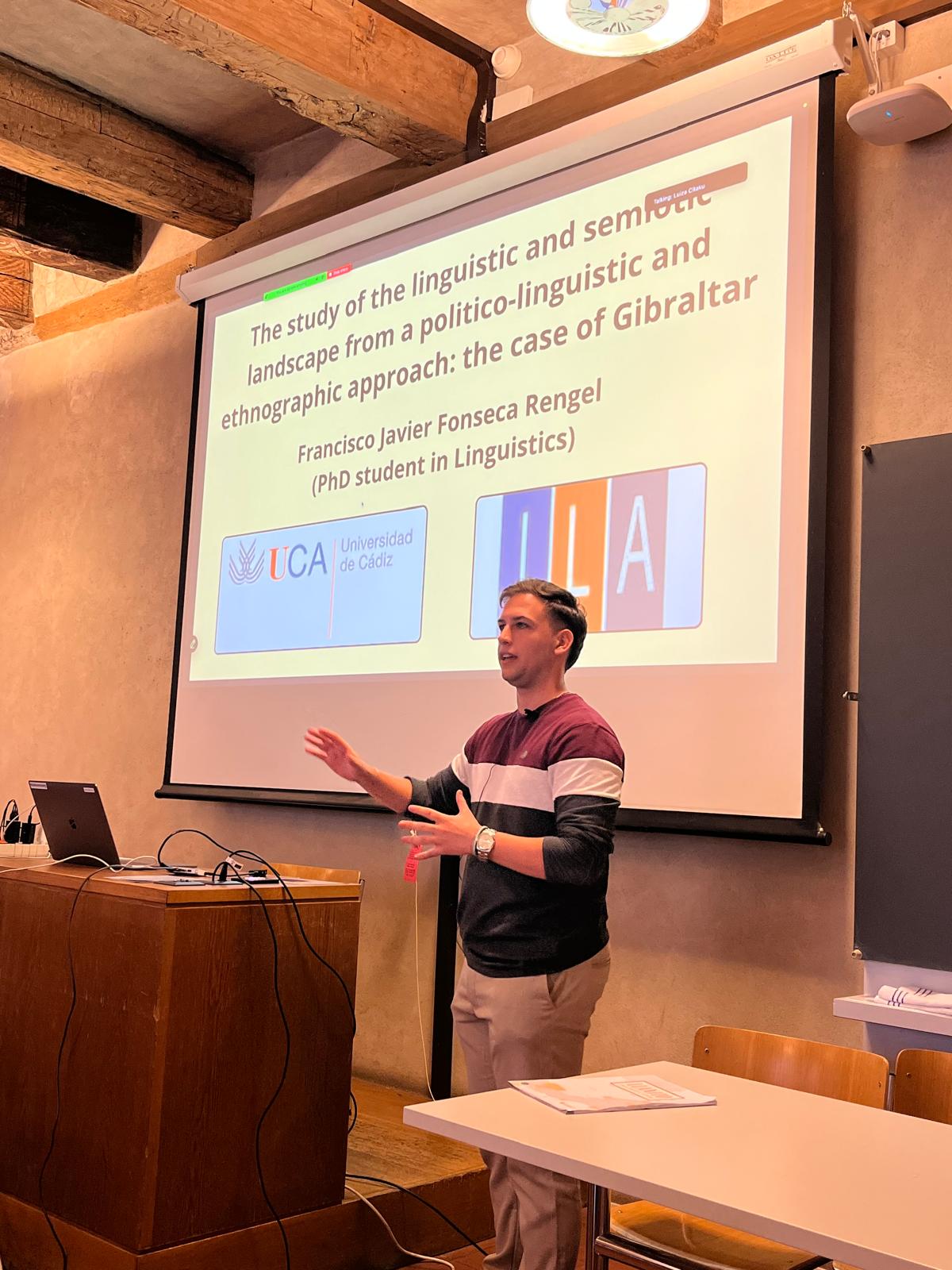
Mr Fonseca has delivered talks on his PhD research at the second and third editions of the Gibraltar International Conference (GIC), held in Vigo (July 2024) and Basel (September 2025).
He says: “During both conferences, I had the pleasure of meeting and talking with wonderful Gibraltarian writers, poets, and people, including Dominic Lopez, M. G. Sanchez, Trino Cruz Seruya, Manuel Enriles, Dale Buttigieg, Rebecca Calderon, Jackie Anderson, Gabriel Moreno, and Jonathan Teuma. I also received very positive feedback from many of them for conducting research on Gibraltar’s linguistic and semiotic landscape, and some even thanked me for showing genuine interest, curiosity, and appreciation for the Gibraltarian community. These experiences have made me feel extremely grateful and have reaffirmed my belief in the social value of my PhD research.”
More recently, on 2 October 2025, he also delivered another talk at the 39th edition of the Congreso Internacional de la Asociación de Jóvenes Lingüistas (AJL 2025), held in Vitoria-Gasteiz (Basque Country, Spain).
He expands: “Firstly, I discussed the academic and social motivations for researching Gibraltar’s linguistic and semiotic landscape. Moreover, I described the focus of my PhD thesis: the use and visibility of languages and non-linguistic elements in Gibraltar’s public spaces. Secondly, I explained the historical evolution of Gibraltar’s population and how English, Llanito, and Spanish (ranked according to their social status and present- day use) became the main means of communication within the Gibraltarian community.”
Mr Fonseca argued that this evolution was shaped by several factors, including the historical contact with the neighbouring population of the Campo de Gibraltar, the evacuation of civilians during the Second World War, the implementation of the British education system in the 1940s, the closure of the frontier (1969-1985), the advent of satellite TV in the 1990s, the consolidation of English as an international language, and the increasing use of English among the younger generations and within Llanito.
He also presented some of the most recent and significant initiatives aimed at promoting Llanito, multilingualism, and Gibraltarian literature that have been carried out by government bodies and local community groups including the public exhibition Llanito: Past, Present, Future, the Heritage Street Name Signs Project, the Multilingual Gibraltar Flag Day, and the publications of Patuka Press.
He said: “Having visited Gibraltar several times since beginning my PhD research, I have observed that English is clearly the predominant language, that Spanish appears occasionally alongside English in some commercial and tourist contexts, and that Llanito is almost invisible in the urban environment. During my talk in Vitoria-Gasteiz, I used these photographs to visually represent the initiatives and efforts aimed at raising the social status of Llanito and fostering positive attitudes towards multilingualism within the Gibraltarian community, including the need to strengthen the level of Llanito and Spanish among the younger generations at home and in education.” By “these photographs”, he refers to images showing some of the new street signs in Spanish and Llanito being installed across Gibraltar, as well as posters with slogans in Llanito displayed during the Multilingual Gibraltar Flag Day.
As part of the event, he introduced two discussion questions to spark a conversation with the audience about how Gibraltar’s sociolinguistic situation might evolve in light of the recent language-related initiatives and the implementation of the post-Brexit agreement. He asked whether recent top-down and bottom-up initiatives would succeed in counteracting the ongoing shift towards English monolingualism and whether they might open a new future for Llanito and Gibraltar’s multilingualism. He also asked how the removal of the frontier between Spain and Gibraltar under the post-Brexit agreement would reshape Gibraltar’s sociolinguistic situation.
He concludes: “I believe that it is crucial to disseminate knowledge about Gibraltar to the Spanish public, with the purpose of challenging deep-rooted negative stereotypes and derogatory sovereignty claims promoted during the Francoist regime and later adopted by certain political groups in Spain. In this respect, I enjoy talking with my family, friends, and PhD colleagues about Gibraltar’s languages, cultures, literature, history, and identity. Fortunately, I perceive that Spanish people’s attitudes towards Gibraltar are generally improving, and that an increasing number of people are becoming fascinated by Gibraltarians’ codeswitching linguistic variety.”



Latest News
- Bluefin Tuna Open Season 2026
- Nautilus World Ocean Day Award Ceremony
- GSD Questions Government Assurances Following Gibraltar Blackout
- Concert Review: A Celebration of Opera - Popov and Novikova
- Chief Minister To Address UN Committee Of 24
- Join Us For A Time To Talk Morning
- PX Group Issues Statement Following Power Failure
- GHA To Install ‘Blood Donor Appreciation Wall’ At St Bernard’s
- Traffic Restrictions Announced For Royal Engineers Association Remembrance Parade
- Minister Feetham's Address At The KPMG Gibraltar Gaming eSummit 2026