
Chief Minister Addresses The United Nations Special Committee On Decolonisation

The Chief Minister Fabian Picardo addressed the United Nations Special Committee on Decolonisation in New York for the last time as Chief Minister.
A statement from the Government follows below:
The Chief Minister, the Hon Fabian Picardo KC MP, today addressed the United Nations Special Committee on Decolonisation (the Committee of 24) in New York for the last time as Chief Minister.
The address came eighty years after Gibraltar was listed as a Non-Self-Governing Territory in 1946, and sixty-three years after Gibraltarians first spoke before the Committee in 1963. The Chief Minister is the fourth Chief Minister of Gibraltar to have addressed the Committee, and has done so more often than any of his predecessors.
In his address, the Chief Minister set out Gibraltar's case for self-determination, referred to the Treaty concluded between the United Kingdom and the European Union in respect of Gibraltar, and called on the Committee to send a visiting mission to Gibraltar and to recommend Gibraltar's delisting to the Fourth Committee of the General Assembly.
The Chief Minister, the Hon Fabian Picardo KC MP, said: "It has been one of the greatest honours of my life to speak for the people of Gibraltar before this Committee. I am the Chief Minister to have delivered the most addresses before the Committee. As I address it for the last time as Chief Minister, I do so in hope, and with confidence in the generation of Gibraltarians who will follow. Our commitment to good neighbourly relations and to our right to self determination remains as strong as ever. I know the Committee will eventually have no choice but to delist us, but that day will come only if we remain steadfast in our defence of Gibraltarian's rights before it."
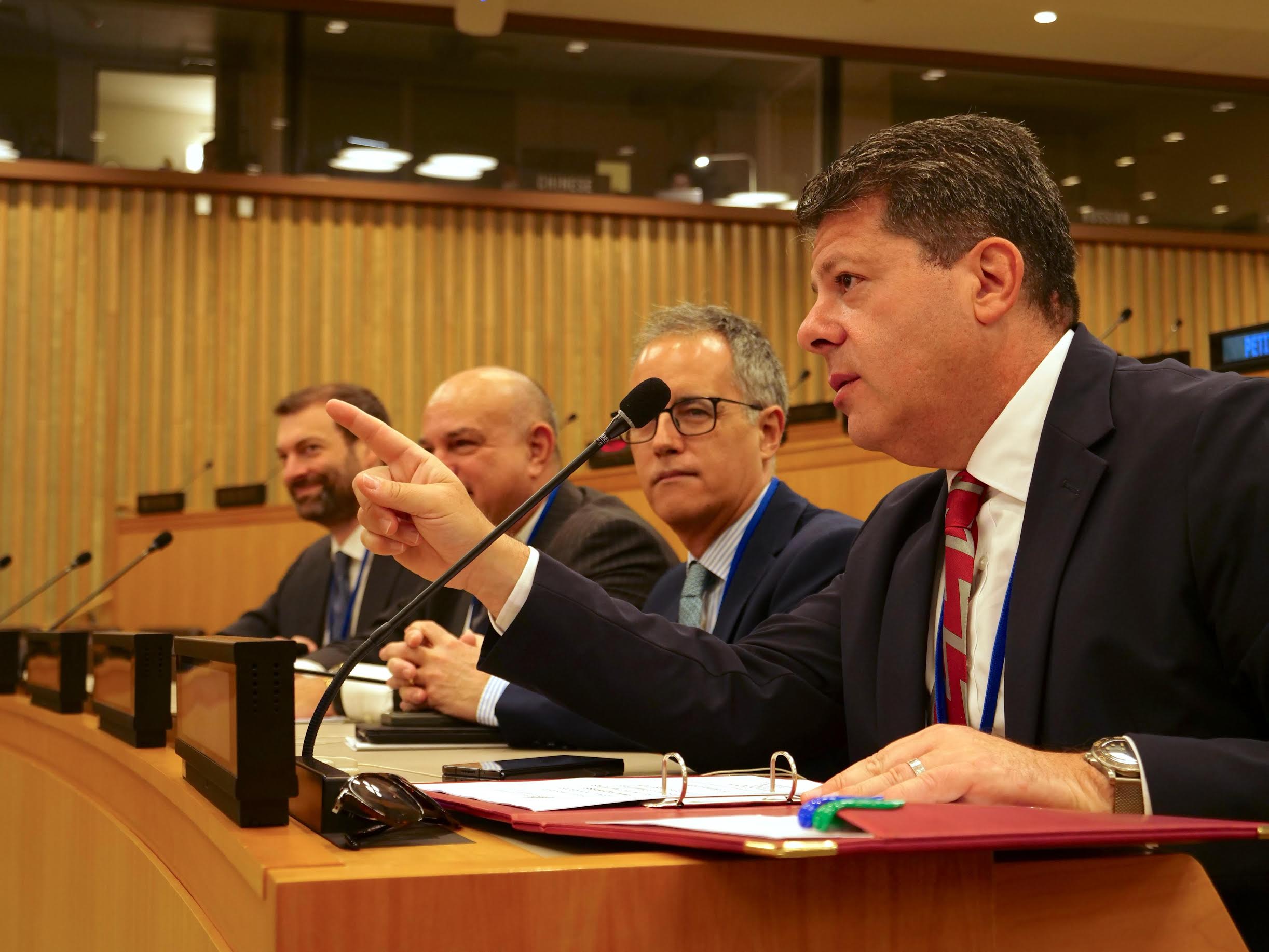
Below follows the Chief Minister’s address to the United Nations Special Committee On Decolonisation:
Madam Chair,
Eighty years ago, in 1946 we were listed as a Non-Self Governing Territory.
EIGHTY YEARS AGO.
That is more than the lifetimes of many of our people.
So, it is clear, Madam Chair, that the arc of decolonisation is long.
In the case of the Gibraltarians, it will bend only towards our just self determination whoever tries to pull it away from us.
It was in 1963 that Gibraltarians first came here to speak for our people. SIXTY-THREE years later, also a lifetime, we are still here. Still speaking.
Still waiting for you to act.
I am the fourth Chief Minister of Gibraltar to have addressed this Committee.
No Chief Minister of Gibraltar has addressed you more often than I have. Today, I address you for the last time as Chief Minister. It may be MY last time.
But I will not be THE last.
There will be more.
A never ending flow, if necessary.
Until you finally act, we will be here.
Until you delist us, we will perservere.
Until you do the right thing, we will come.
Because future generations of Gibraltarians will come to this Committee. Year after year.
Decade after decade, if that is what it takes, until the day you finally do what law, logic and justice demand of you:
Remove Gibraltar from the list of Non-Self-Governing Territories.
Because only THAT will reflect the freely and democratically expressed wishes of its people.
The self determination of our people writ large.
Because, we will never give up our rights.
Never.
I have come here consistently with one message, and I will not change it now.
The right of the people of Gibraltar to self-determination is inalienable. It is a right enshrined in Articles 1 and 55 of the Charter.
It is a right proclaimed in Resolution 1514 of 1960, which applies to ALL peoples of ALL Non-Self-Governing Territories without distinction
And the people of Gibraltar are exactly such a people.
In the language of Resolution 1541 of 1960, we have a status separate and distinct from that of the administering power.
Our right is universal.
It is unconditional.
It is not subject to the veto of any State.
Against that right, what is raised to delay our delisting?
Two resolutions of the 1960s, procured by the relentless lobbying of the dictatorship of General Franco.
Think about that, Excellencies.
The case against the Gibraltarians rests on texts lobbied through this organisation by a tyrant whom modern Spain herself disowns.
Those resolutions are not merely outdated.
In international law and in univeral morality, they are worthless.
No foundation whatsoever on which to deny a people their fundamental rights.
The Gibraltarians defied Franco.
His response was to try to strangle us.
To try to throttle us by closing the land frontier in 1969.
It did not fully reopen for sixteen long years.
Families divided.
Relatives shouting news of births and deaths across no-man’s land.
Franco believed he could besiege the Gibraltarians into submission. He failed.
He failed because he had not reckoned with the will of the Gibraltarians. I am the son of that generation.
I was born behind that closed frontier.
Our parents and grandparents stepped forward so that our community could survive.
War told our grandparents’ evacuated generation to leave forever. But they did not leave forever.
A dictator told our parents’ closed frontier generation to despair. But they did not despair.
This Committee has told our defiant generation nothing. But we will not be ignored.
The future may tell our children's hopeful generation to forget. But they will not forget.
That is the steel from which the Gibraltarians’ resolve is made.
So let no one in this room ever make the mistake of believing that the resolve of the Gibraltarians can be bent.
It cannot.
It will not.
No frontier closure bent it.
No campaign of pressure bent it.
No passage of time will ever erode it.
Yet, Madam Chair, I do not come here today in anger.
I come here in hope.
Because something historic has happened since I last addressed you.
The United Kingdom and the European Union have now concluded a Treaty in respect of Gibraltar.
A Treaty negotiated at the request of the people of Gibraltar and by the Government of Gibraltar.
It is a treaty that will sweep away the physical barriers of a bygone era.
It delivers fluidity for the hundreds of thousands of human beings — Gibraltarians and Spaniards alike — whose loves, lives and livelihoods cross that frontier.
A better modus vivendi between neighbours who share a future. And it does so while leaving sovereignty aside and untouched. Leaving our right to self-determination entirely uncompromised.
Article 2 of the Treaty makes clear that nothing in it, and nothing done under it, affects the respective legal positions on sovereignty and jurisdiction.
It is the tightest without-prejudice clause in the history of documentation on Gibraltar.
Because the Government of Gibraltar has negotiated the Treaty for Gibraltar.
And the UK will only sign and ratify the Treaty because the Gibraltar Parliament has called upon it to do so.
A Concordat between Gibraltar and the UK sets out that implementation of the Treaty is Gibraltar’s responsibility.
Indeed, Madam Chair, it seems that everyone is prepared to recognise our right to determine our future, except the Committee that was set up precisely for that purpose.
The Treaty proves what I have told this Committee for fourteen years:
That the Gibraltarians are not the obstacle to good neighbourly relations — we are its greatest champions.
We can build prosperity with Spain.
We can build friendship with Spain.
We want to.
We are doing so.
But we will NEVER, in exchange, give up our right to self-determination. Cooperation, yes.
Always.
Capitulation, no.
Never.
But let us now build bridges of prosperity where a dictator slammed closed gates of iron.
Knowing that none of this will be finished in my time as Chief Minister. Nor perhaps in the time of my successor.
But knowing, also, that we have begun.
So, Madam Chair, I leave you with three final asks and one promise. First: come to Gibraltar.
Send a visiting mission.
See our self-governing, democratic, prosperous, proudly diverse people. You will not be disappointed.
Second: stop doing nothing.
Sixty-three years of silence is not neutrality.
It is a failure of this Committee’s most basic duty — which is to the people, of the territories NOT to the claims of States.
Third: Once you have seen that we are self-governing, recommend our delisting to the 4th Committee of the General Assembly.
And, finally, my promise.
This is my last address to you as Chief Minister.
As the curtain falls on the last of my interventions before you, do not imagine you have heard the last of me.
I reserve the right to seek to return to this table, if necessary, as a petitioner, speaking for the civil society of my homeland.
The times change, Madam Chair.
Our people will not.
Our rights will not.
80 years have passed since we were listed.
Four Chief Ministers of Gibraltar have come before you. More will keep coming.
So, Madam Chair, let the word go forth from this chamber, to friends, foes and neighbours alike.
The torch of our political freedom is passing to a new generation of Gibraltarians.
They will not ask this Committee for permission to be who we are.
They will ask this Committee only WHEN you finally intend to honour your own responsibilities under the Charter.
So ask not whether the Gibraltarians will ever give up their right to self determination.
Ask only how long YOU will make them wait to recognise it. Because you can wait out a Chief Minister.
But you cannot wait out the Gibraltarians.
Thank you, Madam Chair.
And goodbye.
For now.




Latest News
- SDGG Chairman Speech To UN Decolonisation Committee
- Smartphone Free Childhood Gibraltar Welcomes UK Move To Ban Social Media For Under-16s
- Government Announce Updates To Gibraltar Government Lottery Tickets
- GHA Observes International Domestic Workers
- Government Maritime Services Returns From Positions 2026
- Chief Minister Addresses The United Nations Special Committee On Decolonisation
- Gibraltar Flies Falkland Islands Flag To Mark 44th Anniversary Of Liberation Day
- Interview: Interdisciplinary Artist Hannah Cavilla Latin
- Bluefin Tuna Open Season 2026
- Nautilus World Ocean Day Award Ceremony