
Piano And Cello Recital At The Cathedral of the Holy Trinity

By Giordano Durante
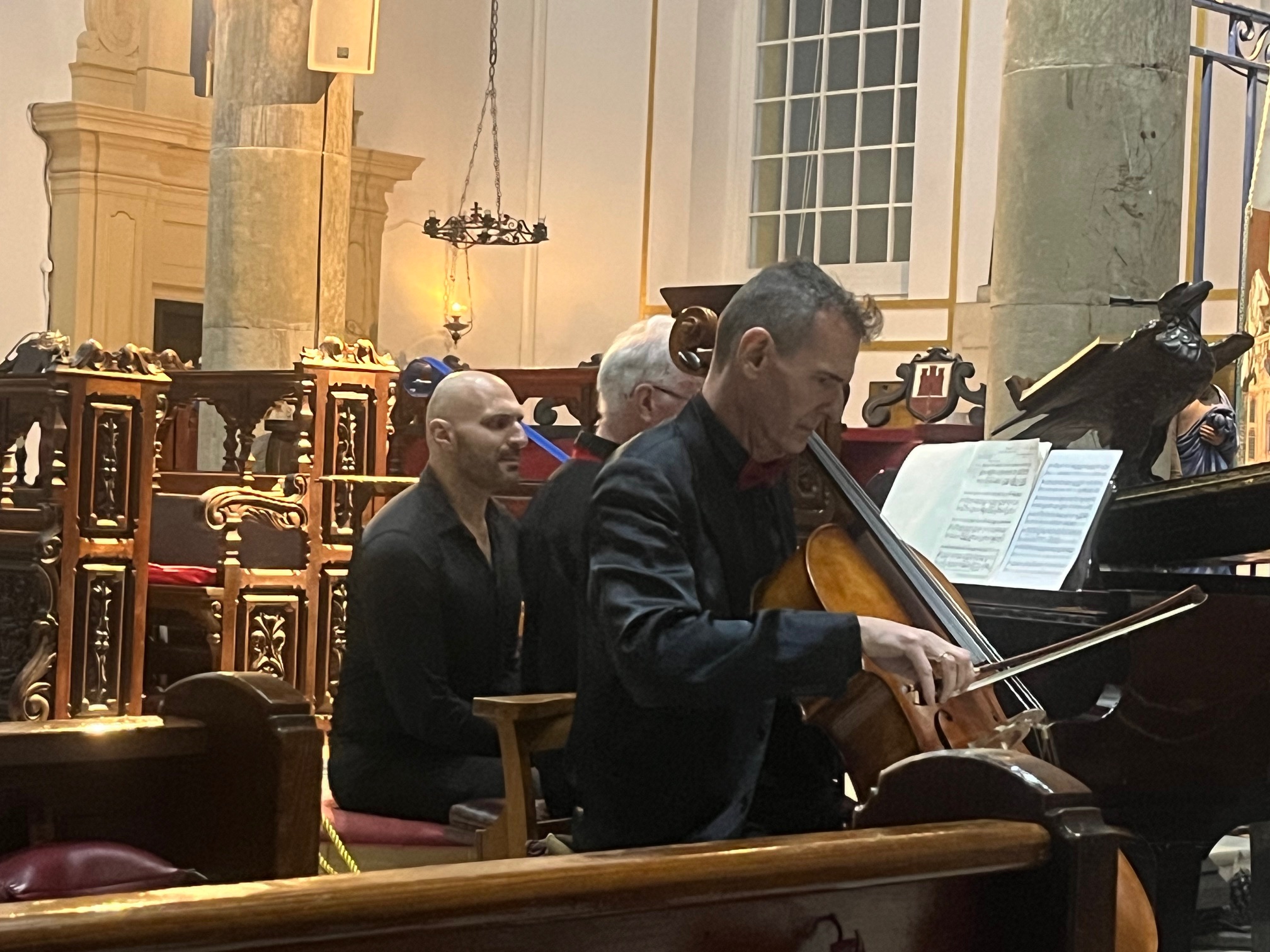
A piano and cello recital took place yesterday evening at the Cathedral of the Holy Trinity. Hosted by the Gibraltar Classical Music Society, the concert featured Michael Kevin Jones on cello and John Bryden on piano performing works by Berteau, Beethoven and Franck.
The Cello Sonata in G Major by the French composer Martin Berteau launched the evening, with Jones delicately playing the stately theme of the Allegro. In the Grave, although the piano was less sonically present in the cathedral’s acoustic, the tender beauty of Bryden’s playing came through. The closing Allegro jolted us from our reverie and ended what was a satisfying interpretation of this work which, with its emotional range, already looks forward to the Romantic era.
Before the next work, the pianist John Bryden addressed the audience. It’s refreshing to see this break with formality and, though only briefly, it’s always instructive to hear from the performers themselves.
The duo then tackled Beethoven’s Cello Sonata in F Major, its low opus number (5) indicating that this was an early work. Already, we could see how the cello sonata form had developed from Berteau’s time: the piano takes on a more prominent role and Bryden was positively pounding away at those chords as he followed Beethoven’s emphatic score.
The introductory Adagio Sostenuto possessed one of those typical Beethoven themes: tragic, deep-felt and yet carrying within it the germ for future development. In the central Allegro, the main theme had a sense of possibility and forward movement so characteristic of this composer. There’s always a feeling, even in early Beethoven, that the composer is writing for the very limits of the instruments at his disposal, and this was clear in the closing Rondo where an ostensibly civilised main theme underwent an increasingly frenzied development. This final movement included some pizzicato work from Jones and drone-like effects, a virtuoso display of the sounds that players can coax from this magnificent instrument.
Both Jones and Bryden brought across the sense of tension and vigour in this piece while remaining emotionally alert and surmounting technical challenges effortlessly.
After the interval, the audience was treated to the big, muscular sounds of Cesar Franck’s Cello Sonata in A Major, a cello and piano setting of his 1886 Violin Sonata. The Allegretto was well-paced, with Jones and Bryden giving the music space to breathe. The tension in the music was well conveyed by the pair, alternating declamations by the cello with more reflective piano accompaniment. A flurry of notes ushered in the tempestuous Allegro which then led to the central Recitative and Fantasia, the emotional core of the piece. The initial cello theme here always reminds me of Bach so listeners are, in a sense, transported back to his Cello Suites, the mighty ancestors of all subsequent cello music in the repertoire. After so much heat and drama, the closing Allegretto charmed us with the child-like directness of its main theme. Although we’re more used to encountering this work in its original violin incarnation, Jones and Bryden were powerful advocates for this version, filling the cathedral with Franck’s impassioned music.
Enthusiastic clapping brought the pair out for an encore—Camille Saint-Saëns’ ‘The Swan’—a tender conclusion to the evening’s entertainment.
The programme was thoughtfully put together to display the stylistic progression from Berteau to Franck. We were able to chart the evolution of the cello sonata form and appreciate the expressive and technical advances undergone by this chamber combination.
Bryden and Jones, who have recently recorded an album together (‘Cello Meditation’), were a captivating duo throughout in a performance brimming with commitment and personality. Their efforts were proof of the words of Phillip Borge McCarthy, one of the society’s directors, who said at the start of the concert that the cello is an instrument that “really does sing.”




Latest News
- Clarification of Transitional Beach Arrangements for Accessibility Services
- Royal Gibraltar Regiment Holds Second Insight Weekend
- BabelBrain Research Project on the Rock Aims to Study Multilingual Practices
- Government And Unite Agree £24,413 Minimum Entry Salary For Public Service Staff
- East Side Project Exclusion Zone
- Gibraltar Joins Celebrations of Overseas Territories Day in Westminster
- GSD: "Concerns Over Availability of Accessibility Services and Lifeguard Services – Announcements Must Match Reality"
- Gibraltar Horticultural Society Launches “In Nature” Art & Photography Competition 2026
- GSD To Hold AGM On Thursday
- The Peter J Isola Foundation Donates Vehicle To Children’s Residential Services