
BabelBrain Research Project on the Rock Aims to Study Multilingual Practices

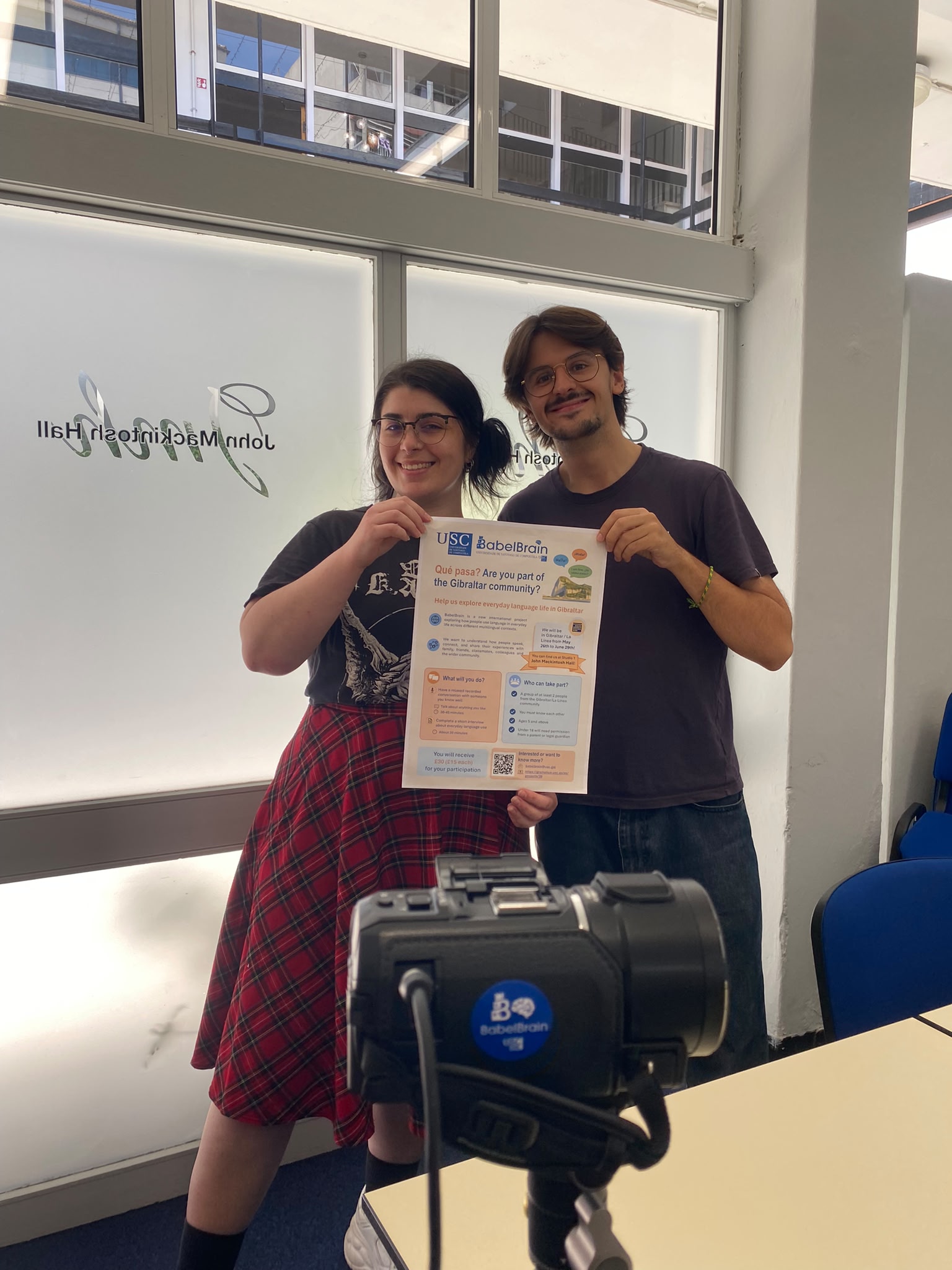
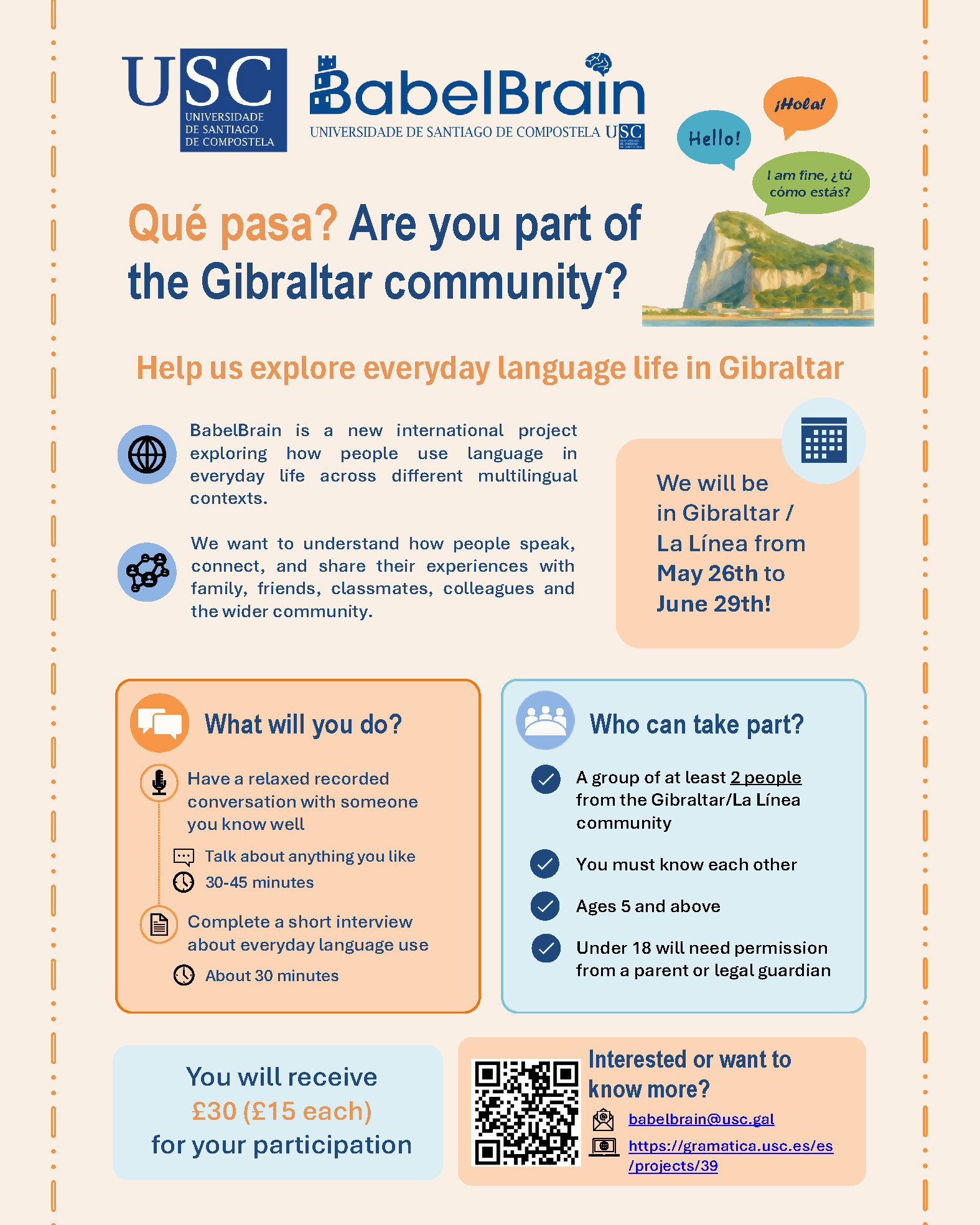
Two researchers will be recording conversations and conducting interviews with people from Gibraltar at the John Mackintosh Hall during the month of June as part of an interdisciplinary project led by the University of Santiago de Compostela.
The ‘BabelBrain: Mapping multilingual ecologies’ research project—led by Maria Carmen Parafita Couto, Distinguished Researcher at the University of Santiago de Compostela — will investigate multilingual practices in Galicia and Gibraltar. Both communities speak languages that have experienced a decline in the number of speakers (Galician in Galicia and Spanish / Llanito in Gibraltar) and the researchers are keen to explore parallels between these two populations.
Tasked with collecting the data are Lucía Vieitez Portas, a postdoctoral researcher who obtained a PhD in Experimental Psychology in 2025, and Hugo Parra, who is currently a PhD student in Linguistics.
The information-gathering sessions at the John Mackintosh Hall will involve recording participants while they have a natural, unplanned conversation. After this, participants will answer a sociolinguistic questionnaire about the languages they speak and with whom they speak those languages.
Ms. Vieitez Portas explains the approach: “We’re trying to explore day-to-day conversations. In a place where different languages are present, we want to see what impact this has in different situations. For example, depending on who you’re talking to, we choose a particular language.”
Mr Parra explains: “We want to see in what contexts people use Llanito; whether it is used more in one context than another or whether there is a generational gap.”
One of the most striking developments in Gibraltar is the loss of Spanish and Llanito among the younger generations.
Ms. Vieitez Portas explains that language loss in Galicia is following a similar pattern: “In Gibraltar we are finding that the decline is affecting the younger generations, which is the also the case with Galician. When younger speakers speak to their grandparents, sometimes they can’t be understood. In Galicia they can understand their native language but they aren’t talking it so there is a disconnection between the generations.”
In both communities, she notes, there is also a “political aspect intertwined with language use” which can make it difficult to make changes because people might associate an attempt to bring up multilingual children with a particular political view.
She adds that, in both places, at various points in history, speaking one of the languages was prohibited in schools and that speaking Galician is still associated with not being fully educated or with being a person who has a low economic status.
“Parents would tell their children not to speak Galician,” she says.
Mr Parra says he is also fascinated by how the historical background influences which languages are spoken today in Gibraltar: “I found a paradox very fascinating: that the older generations, who have been most affected by tensions with Spain, speak Spanish most fluently but the younger generations, who might not have experienced the same problems, don’t speak Spanish. With the border opening, all of these dimensions become very interesting to us.”
In recent years, researchers have been drawn to Gibraltar’s linguistic community because it engages in code-switching: the flipping between languages, often in the same sentence, during conversation.
Speakers in Galicia also frequently code-switch between different languages and the project will seek to understand what similarities exist between these two cases. They hope the results from BabelBrain will advance a “comprehensive theory of multilingualism and help counteract the common disparagement towards multilingual practices.”
The research duo are hoping to speak to representatives of every generation and are aiming for a minimum of at least 100 participants. The same study will be conducted in Galicia too and they will return to Gibraltar in 2027 or later with the project coming to a conclusion in 2029.
The researchers will be at the John Mackintosh Hall (Studio One) every day until the 29th of June from 9 am to 7 pm but are also able to meet people at other times and locations. Contact them at [email protected]. Participants in the study will receive £15 each. All research data is completely anonymous.
Tomorrow, YGTV will post a detailed interview with principal investigator Maria Carmen Parafita Couto where she discusses code-switching and some striking similarities between Llanito and bilingual communities in the United States.




Latest News
- Clarification of Transitional Beach Arrangements for Accessibility Services
- Royal Gibraltar Regiment Holds Second Insight Weekend
- BabelBrain Research Project on the Rock Aims to Study Multilingual Practices
- Government And Unite Agree £24,413 Minimum Entry Salary For Public Service Staff
- East Side Project Exclusion Zone
- Gibraltar Joins Celebrations of Overseas Territories Day in Westminster
- GSD: "Concerns Over Availability of Accessibility Services and Lifeguard Services – Announcements Must Match Reality"
- Gibraltar Horticultural Society Launches “In Nature” Art & Photography Competition 2026
- GSD To Hold AGM On Thursday
- The Peter J Isola Foundation Donates Vehicle To Children’s Residential Services