
Book Review: ‘Gibraltar’ by Gabriel Moreno

By Giordano Durante
Gibraltar is the fifteenth book by local singer-songwriter and poet Gabriel Moreno. Released in February this year, the volume is a bilingual English/Spanish edition produced in collaboration with Rafael Peñas Cruz, founder and editor of Goat Star Books, a UK-based publisher that specialises in translations.
Part one of the book, titled ‘The Rock’, consists of ten poems in search of the ungraspable spirit of Gibraltar. Part two presents twenty ‘Llanito Sonnets’—code-switched experiments in an established literary form. The third part of the collection contains new poems, and the fourth and final section re-prints five poems published in Spanish while Moreno was in Barcelona. Throughout, Moreno’s poems are accompanied by facing-page translations by Peñas Cruz, opening up the early, Spanish poems to a wider anglophone readership while also making the English and bilingual poems comprehensible to more readers.
Peñas Cruz’s wide-ranging prologue situates Moreno’s work in the wider Mediterranean zone, regarding it as both an expression and a product of the fusion of identities and cultures that has conspired to make Gibraltar what it is today. He says, on first meeting Moreno: “We both seemed to inhabit a liminal space in which you don’t know where one culture begins and the other ends.”
This fluid movement between historically dominant cultures, this negotiation between overbearing external influences is, he argues, one reason why Gibraltar is sui generis: Gibraltar, Peñas Cruz says, is neither a town in Andalucía nor a place in England but “just itself.” Although these debates about influence and identity have typically been the preserve of the political class, Peñas Cruz makes the case that it is poets who “ultimately give shape to that immaterial set of shared beliefs, values, customs, behaviours, and ways of life” which are peculiar to a people and the place they regard as home.
His editor and translator sees Moreno as engaged in a search for the spirit of Gibraltar. One might detect here a slight whiff of hyperbole, but isn’t that what poetry is, almost by definition? We go to poetry for exaggeration, for grand gestures, to meet language on steroids. If what we want is measured, precise, sober and clinical argument, we should stick to instruction manuals.
Accurately identifying Lorca and Leonard Cohen as Moreno’s two guiding muses, Peñas Cruz then offers a short history of Gibraltarian literature, underlining the emergence of native, non-military perspectives in Joyce’s Ulysses and Hector Licudi’s Barbarita. He explains that, with Elio Cruz’s Llanito plays of the 1960s, the “stepping stones” are laid which lead towards today’s generation of authors whose writing is “unapologetically” from a local viewpoint.
The ten poems which make up the first ‘Gibraltar’ section see Moreno in an all-encompassing, Whitman-like mood where the lyrical impulse seeks to free us from being hemmed in by definitions, flags and colonial history. His attempt to pin down the spirit of the Rock is cliché-free and receptive to the complexity and plurality of Gibraltarian identity with the mention of the “thousand Gibraltars”.
In the opening line, “Gibraltar is also you and me”, that “also” implies that this statement comes after something that has already been said; it is supplementary or additional to something implicit, even before the poet has started his song. Moreno’s opening line therefore seems to acknowledge that his contribution is labouring under the weight of history, of the already sung and spoken, and the ten poems that follow are a careful display of how the personal and the historical are tightly intertwined and inseparable in this sustained reflection on mixed heritage and language.
Gibraltar’s colonial past is hinted at with lines like “watchmen in wigs” and “the pickings of the lords”—these images of authoritarian control are contrasted with a freer, poetic spirit that ranges across borders. In the second poem, echoes of Lorca seem to embody this poetic presence: “A necklace of nacre torn / from the body of the moon.” Moreno has a gift for selecting the apposite image to make vivid the tug and marriage of the different cultures that meet in Gibraltar: red post boxes, those quintessential symbols of British colonial rule, hold not official reports for Whitehall but “Andalusian love letters” and, later, “Saxon orders” might appease “Latin dreams.”
There’s a rebellious edge here, too, with Moreno’s poetic persona adopting a stand against borders and other divisions and urging us, at one point, to “shred the flags” and a subsequent cry of “down with rulers and gates!”. However, the emotional turn comes when the poet talks about his father, an absence that cannot be ignored. Once again, one’s immediate ancestry is linked to the heritage of one’s hometown, an interdependence made explicit in the term ‘fatherland’ which is both the land where we belong and the land of our father(s).
As we have come to expect from his previous work, Moreno’s language is lush, often wallowing in the beauty of sounds: “Where our smuggling fathers slept” is just one sibilant example I could mention of this sensitivity to the music of words. He’s also able to pile surreal image on top of surreal image without any sense of excess or saturation in lines that are not, like those of other poets, merely prose chopped up conveniently.
In the twenty Llanito Sonnets, the book takes an experimental turn. There were doubts about whether Llanito, our language of the street and home, could be bent to fit the formal scaffolding of the sonnet with its fourteen lines and rhyme scheme. Moreno’s sonnets convince this reader that such doubts are groundless—instead, the straitjacket keeps Moreno’s nostalgic excursions formally tight as he ranges over smuggling, adolescent nights out, childhood games, and summer flings. This interplay of freedom and control is manifest in ‘The Sonnet (For Ian Duhig)’, where the literary form is “un sonnet de piedra que libera y engaña”—“a soneto of stone that liberates and deceives” in Peñas Cruz’s translation.
The translation of code-switched Llanito has always posed a headache for writers. If one simply turns a code-switched text into standard English or Spanish, one makes it intelligible to monolinguals but leaves out its hybrid, bilingual character. Peñas Cruz’s solution is unusual: he translates the Spanish/Llanito words in Moreno’s sonnets into English and vice versa. That result is not, for clear reasons, idiomatic Llanito, is proof of the rule-bound nature of our code-switching but this loss of elegance is worth the gain in making these poems accessible to a new audience without the flattening of monolingual paraphrase. His approach is, thankfully, not literal but alive to the poetic weight and flavour of each line, often liberally departing from the original.
Another reasonable doubt is whether the resources of Llanito are sufficient for the exalted nature of poetic expression—the question is not one of vocabulary but of whether we can slip into that elevated poetic voice while still sounding authentically Llanito and avoiding pastiche. Moreno knows this and, rather than stretching Llanito to fulfil a task that it was never meant to face, rather than trying to sound, in other words, like the Keats of la Laguna, in these poems he avoids the surreal and rhapsodic elements of the first section of the book in favour of a more down-to-earth idiom; like a chameleon, he switches his poetic language to fit the hoard of words and expressions at his disposal. The result is more like the yearning, drunken reflections of washed-out punters in an Upper Town tavern than the dreams of Lorca and Whitman. In ‘Pillars of Hercules’, for example, the use of Llanito makes Greek myth informal, once again demonstrating that our vernacular often serves to cut broad domains—history, colonial influence and their pretensions—down to size.
A biting self-consciousness about language, accent, class and education is present in ‘El Copacabana’, a further meditation on how Gibraltarians are fated to inhabit different worlds without ever being entirely at home in any of them, another sign of our messy complexity.
Links with the work of the novelist M.G. Sanchez are clear in ‘El Reclamation’ and ‘La Frontera’ where childhood memories and crossing the border with smuggled goods take on a quasi mythological status. When Sanchez relates everyday, mundane memories in highly descriptive prose, and when Moreno places them in a sonnet, the ordinary is transformed and given a veneer of glory and permanence.
In ‘Detention en St. Paul’s (For Aaron Turner)’, a line from Gil de Biedma crops up when school punishment prompts a deeper rumination on life’s trajectory. Where Gil de Biedma’s clean-cut lines make a philosophical point about time and ageing, Moreno is blunter about childhood ignorance and innocence, with him and his friend stuck in a classroom, “Sin puta idea que la vida iba en serio”.
In part three of Gibraltar, Moreno publishes works written in English with their corresponding Spanish translations by his editor. Here we are back with familiar Moreno themes and characters: underdogs, drunks, vagabonds and other outcasts; reflections on the hollowness of fame and easy money and the role of the poet. These poems are also attuned to the present moment of global strife: in ‘Letter to Wilfrid’, for example, we read: “My son, there are years when blood is more fashionable / [than water”. Moreno also reflects on fatherhood, having moved on from the ambivalent image of this role in the Llanito Sonnets to the first person perspective on his position as a father to his son. He’s also particularly good at drawing the reader’s attention to the dangers of artistic compromise and the sacrificing of integrity for the sake of quick buck:
one starts writing
ditties for moguls
and ends up
erecting
golf courses
over the bones
of infants. (‘Epistola ad Pisones’)
Of course, we all know of at least one political figure with a penchant for golf courses!
In a later poem, he admires ‘Pablo’ for being “nobody’s clay” again pitting the artist against the crushing influence of the market.
One of the best poems in this section opens with the following arresting stanza which sees the past—the poet’s childhood in a Gibraltar housing estate—come to haunt the present:
The day I read at Keats’s House,
a sparrow perched on my window.
Tied around its leg it bore a note.
The note said: Varyl Begg Estate. (‘The day I read at Keats House’)
What follows is a vulnerable study of inferiority, background and language as the boy from a council flat suddenly finds himself reading in the house of a major Romantic poet, a centre of the London cultural establishment.
The remainder of the collection re-prints a handful of poems that were originally published by Omicron during Moreno’s years in Barcelona (2007-9). It’s useful to have them here as they appear in books that are now difficult to source. Perhaps Moreno could consider a collected edition bringing together all his books at some point.
Fifteen books in, there are no signs that the poetic flame inside Moreno is dimming or even flickering. If anything, a rapidly changing world is prompting a flurry of new verse—he has, as he writes in ‘The Current of Time’, his “torso loaded / with poems and songs.” For a poet who is so prolific, the danger might be that he might run out of things to say or repeat himself. However, the vexed matter of the encroachments of the market into the creative sphere and the growing confidence in the use of Llanito as a medium of literary expression are recent developments that have given a new boost to Moreno’s verse, keeping it relevant and vigorous.
Peñas Cruz notes in his prologue that it is “felicitous” that the book’s publication coincides with the upcoming EU-UK treaty. Although Moreno is not explicitly a political poet—there are too many moons and lusty bullfighters, not enough certainty—his attempted cartography of the Gibraltarian spirit is a valid contribution to the current debate on the future of our identity. His poems, although they are about much more than mere identity, should shake us from the narcotic sleep induced by the facile slogans peddled by the UK tabloids and others.
‘Gibraltar’ by Gabriel Moreno is available at local outlets and online: https://goatstarbooks.com/store
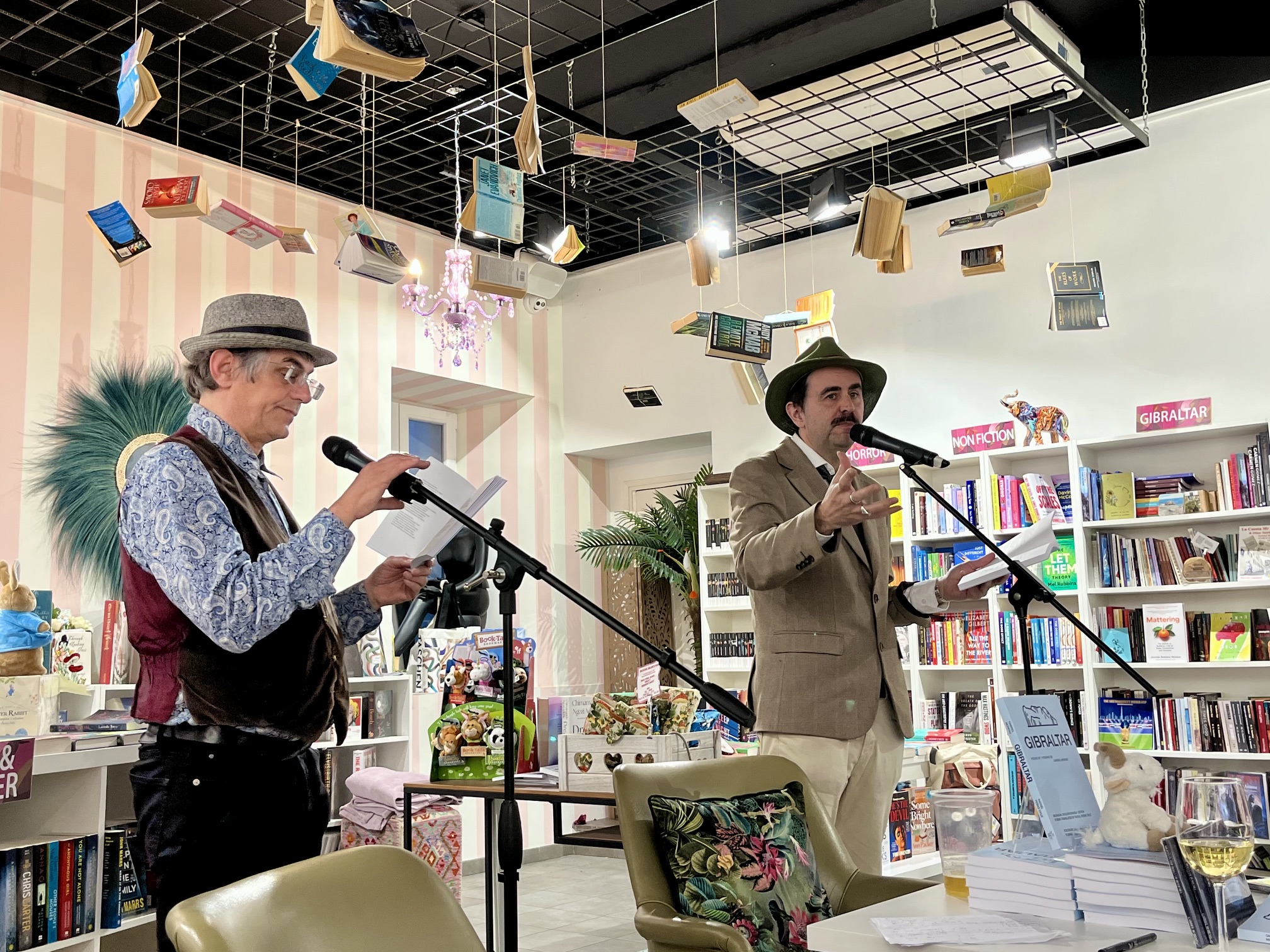
Pic below: Peñas Cruz and Moreno at the book’s launch earlier this year.




Latest News
- Gibraltar Removed From Spain's List Of Non-Cooperative Jurisdictions
- Minister Santos Presents NVQ Certificates To Apprentices And Trainees From Gibraltar Training Centre
- GSD Raises Concerns Over Frontier Conditions Ahead Of Treaty Implementation
- Frontier Works Completed Ahead Of Schedule - Eastgate Night-Time Diversion Lifted
- Book Review: ‘Gibraltar’ by Gabriel Moreno
- Gibraltar National Archives Launches Call For Public Submissions For “Gibraltar At The United Nations 1946–2026” Exhibition
- Exclusive Event With John Suchet For The Gibunco Gibraltar Literary Festival 2026
- Art Exhibition By Year 8 Students Explores Llanito
- Busy Training Period At The Airport Fire And Rescue Service
- Gibraltar Attends Commonwealth Foundation Board Of Governors Meeting In London