
Stunning End of Season Concert in the Spitfire Hall

By Giordano Durante
The Gibraltar Classical Music Society hosted a stunning performance of Karl Jenkins’ The Armed Man: A Mass for Peace yesterday evening in the Spitfire Hall of the World War Two Tunnels. This was the second of two performances of this modern work this week, with the event bringing to an end the society’s season before the summer break.
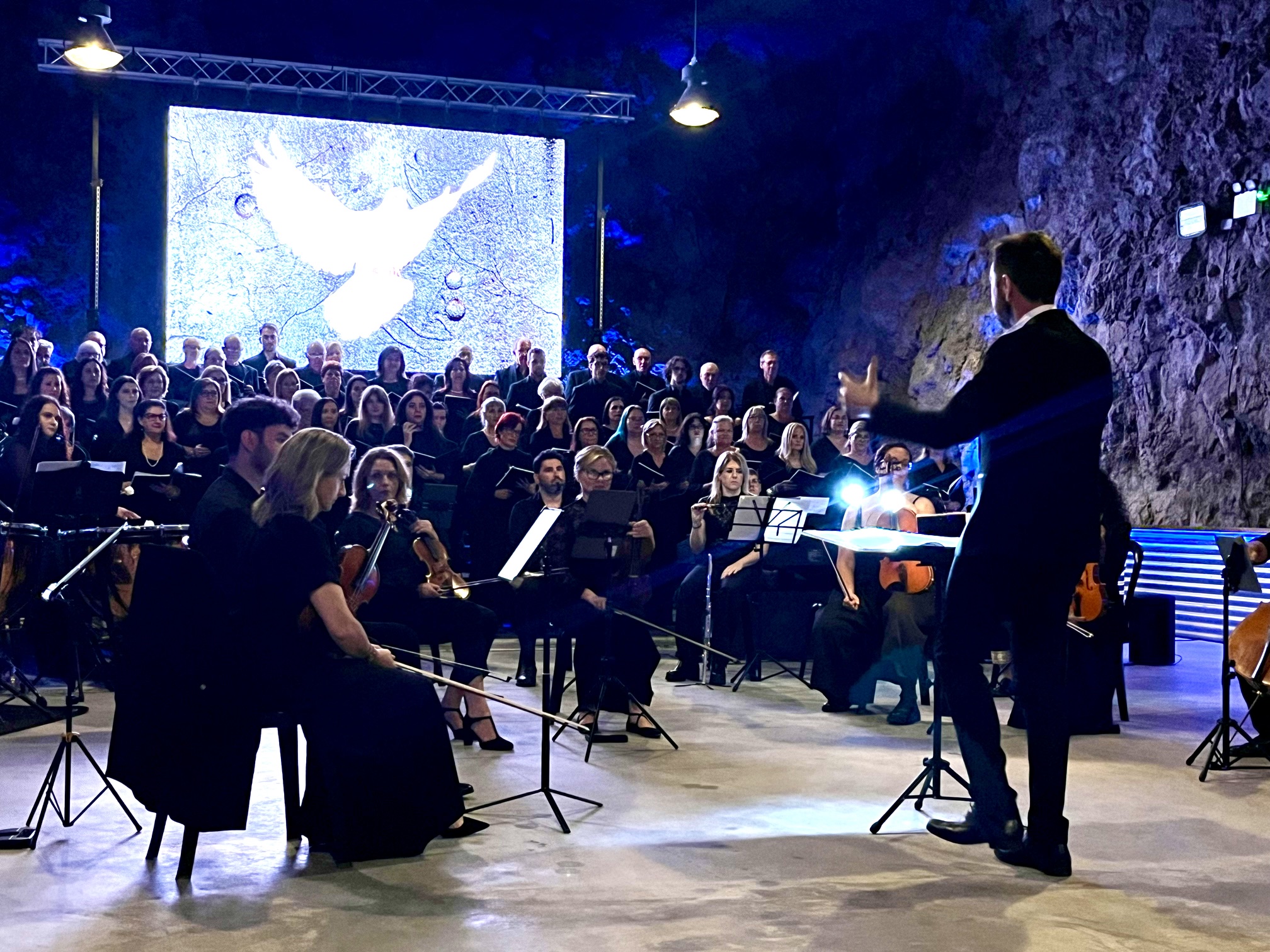
The concert involved the Harmonics choir from Gibraltar, the Chorus Insubriae from the University of Varese, Italy, the Zyriab Choir from Algeciras, and a small orchestra conducted by Michele Paccagnella.
Composed in 1999, The Armed Man, by Welsh composer Karl Jenkins, is a multi-movement work that reflects on the death and destruction wrought by war in the 20th Century. It was last performed locally in 2018 during Armistice week. The work charts a journey from despair to consolation and peace packed with military marches, religious feeling, startling thumps, wails and music of sublime inspiration. Although billed as a ‘mass’, it includes elements from different cultures and religions to emphasise the universality of its message.
The thrilling opening, a strident march based on a French folk tune, was enhanced by the presence of two men dressed as soldiers and a screen showing footage of military parades, planes, tanks and missiles. This was a multi sensory performance: it could be seen and heard, obviously, but, most importantly, it could also be felt in our bones and flesh.
All the forces present—both choral and instrumental—were on form for this vital positive first impression. This was followed by the Muslim call to prayer delivered by a pre-recorded muezzin.
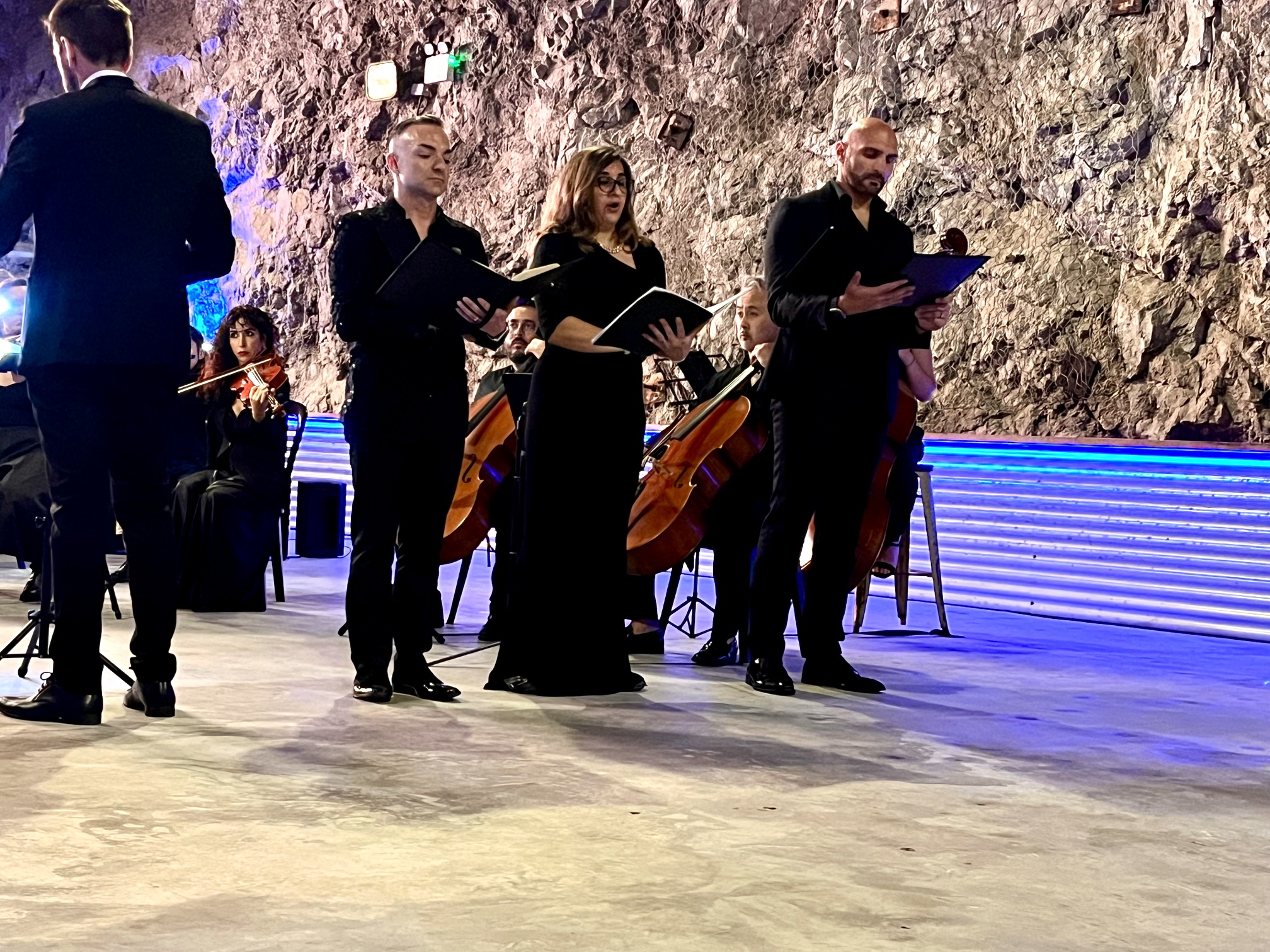
The ominous strings that opened the Kyrie were the prompt for local singers (and Gibraltar Classical Music Society founders) Anthony Roper de Almeida and Philip Borge McCarthy to take the stage for this movement which took us back to the world of Mozart and earlier composers like Palestrina. This was followed by Save Me From Bloody Men, set to Psalm texts, with a bass drum strike that made some audience members jump. Jenkins’ work was full of such surprises and climactic moments, never letting listeners settle, an appropriate effect given that the music is meant to convey the horrors of battle.
Michele Paccagnella deserves special mention; we’ve followed his interpretations for a few years now and it’s always instructive to watch the Italian conductor as his gestures shape the music. He adopts sensible tempos and, even with the challenge of shepherding the various forces through stylistically diverse scores, he is unfailingly disciplined and calm.
Just like in last year’s Carmina Burana, the following Sanctus had a rhythmically challenging pulse. Jenkins’ use of the instrumental forces is striking with full orchestral outbursts contrasted with more intimate, chamber-like sections.
The influence of film music and the English choral tradition of Elgar and Parry were evident in the Hymn Before Action and Charge! saw a return of the martial trumpet building to a thrilling climax with the trumpet then moving off-stage for a rendition of the Last Post.
Philip and Anthony were then joined by Tessa Pitto Duarte for Angry Flames, a setting of a poem by a Japanese poet about the effects of the atom bomb dropped over Hiroshima in 1945. This was not a tonally straightforward piece and all three singers did well to convey the emotion that was in its text but perhaps not on its musical surface.
Torches, part of a Hindu epic, was followed by the Agnus Dei—a moment of consolation and the first whiff of peace after the bangs and laments of earlier movements. Here, rather than marching music, the trumpet’s tune was gentle and pastoral. Echoes of the music of Benjamin Britten, whose 1962 War Requiem stands as a predecessor to this work, could be detected as Anthony tackled Now the Guns Have Stopped, his hours of practice evident in his confidence.
The emotional heart of the piece—the Benedictus—started with a lengthy, serene cello solo. The moment when the choirs entered was spell-binding and completed the total transformation of the mood of the work in its last third. The conductor Michele was busy juggling all the elements during the hosanna part, transmitting all its shifts in mood and purpose.
The French folk tune that opened the work returned for the final movement but with a modified message: now, instead of “L'homme armé”, the choruses sang “Better is peace than always war”, the music no longer a war-like march but a jolly fairground tune. The cycle complete, we had moved through pain to peace and a mood of celebration with the unaccompanied hymn from the Book of Revelation closing the work not with a superficial or naive embrace of peace as an unrealistic ideal but on a more complex and ambiguous note.
Putting together a performance of such an emotionally draining, polystylistic work is undoubtedly hard work. Three choirs, a small orchestra and soloists nevertheless played as a unified whole and as if they had known this piece all their lives. Just like last year’s season closer Carmina Burana, the performance was a triumph. The audience, including this reviewer, left the hall having been altered by the music and prompted to think of wider matters in a world that is increasingly marked by conflict—surely that is a clear sign that those dedicated to making music possible have succeeded in their task of translating notes on a score into feelings and reflections that will last long after the applause.
For further info about the society and upcoming concerts, visit: https://thegibraltarclassicalmusicsociety.com




Latest News
- Stunning End of Season Concert in the Spitfire Hall
- “Code-Switching Is A Skill, Not A Deficit” Says BabelBrain Principal Investigator
- Gibraltar Citizen’s Advice Bureau Celebrate Volunteer’s Week
- Gemma Arias-Vasquez Announces GSLP Leadership Bid With Feetham’s Support
- Entries Open For ‘Our Gibraltar’ National Celebrations Competition
- SSAFA Gibraltar To Host Charity Concert At St Michael’s Cave
- Clarification of Transitional Beach Arrangements for Accessibility Services
- Royal Gibraltar Regiment Holds Second Insight Weekend
- BabelBrain Research Project on the Rock Aims to Study Multilingual Practices
- Government And Unite Agree £24,413 Minimum Entry Salary For Public Service Staff